
Birth Chart Online: How to Create and Interpret It Step by Step
Searching for a birth chart online is usually the first real step into astrology, because it turns a vague interest into something concrete, personal, and readable. Instead of guessing from general horoscopes, you can generate a chart that maps the sky at the exact moment and place you were born. That chart is often called a natal chart, and it can reveal your core drives, emotional habits, relationship patterns, and the kinds of situations you tend to meet in life. The good news is that you do not need to be an astrologer to begin reading one. You only need the right birth details, a trustworthy calculator, and a simple order of interpretation so the chart does not feel overwhelming.
This guide is designed to help you do exactly that. You will learn what a birth chart is, how to create one online step by step, what information you need before you start, and how to make sense of the main chart elements without jargon. You will also see how different chart settings, formats, and astrology systems affect what you are looking at. If you have ever opened a chart and felt lost in the symbols, this article will give you a practical framework you can actually use. The goal is not to memorize every astrological rule, but to understand how to read the chart in a grounded, useful way.
Because this topic sits between curiosity and self-investigation, it also helps to know what online tools can and cannot do. A calculator can generate the chart with impressive precision, but the interpretation still depends on context, nuance, and the quality of the input data. That is why this article includes both creation steps and reading steps. You will learn how to check the reliability of what you enter, how to handle unknown birth times, and when a free calculator is enough versus when a deeper reading may be more useful. If you want a simple, human-friendly starting point, this is the map.
By the end, you should be able to open a chart and answer the basic questions: What does this symbol mean? Where should I begin? What matters most? And how much of this is actually dependable? That is the real value of a birth chart online tool when it is used well. It is not just a pretty wheel or a list of placements. It is a structured way to translate a birth moment into a pattern of meaning.
What a Birth Chart Is and Why Online Calculators Are the Easiest Way to Generate One
A birth chart, also called a natal chart, is a symbolic map of the sky for the moment you were born. It shows where the Sun, Moon, planets, and key points were positioned by sign and house, and how they related to one another through aspects. In astrology, these placements are not treated as random decoration. They are read as a pattern of tendencies, motivations, sensitivities, and life themes. A chart does not tell you everything about a person, but it offers a remarkably structured way to understand recurring habits and deeper developmental themes.
Online calculators are the easiest way to generate a birth chart because they do the technical work for you. In the past, chart calculation required ephemerides, tables, and manual correction for time zones and geographic longitude. Modern tools handle those details instantly, which means beginners can focus on interpretation instead of arithmetic. You enter the birth date, exact time, and place, and the system produces the chart wheel, degrees, house placements, and often a written summary. For most people, that is the fastest and least intimidating way to begin.
It helps to understand that the chart itself is not the interpretation. The chart is the raw structure. Interpretation comes from reading the placements in relation to one another, and from noticing which themes are repeated. A Sun in Aries means something different when it is in the 10th house and squared by Saturn than when it is in the 4th house and trined by Jupiter. This is why a birth chart online tool is useful but not sufficient on its own. It gives you the data; you still need a reading method.
Many beginners also assume that a chart must be deeply mystical to be meaningful. In practice, the most helpful way to read it is often psychologically and symbolically. A chart can reflect how someone approaches decision-making, intimacy, risk, identity, work, emotional security, and personal boundaries. That makes it useful for reflection even if you are skeptical about predictive astrology. The language of the chart is symbolic, but the patterns it describes often feel surprisingly familiar once you know where to look.
The basic building blocks of a natal chart
Every natal chart is built from a few core layers. The planets represent functions or drives, the signs describe style, the houses show life areas, and the aspects describe relationships between parts of the chart. If that sounds abstract at first, think of it this way: the planet is the actor, the sign is the costume and tone, the house is the stage, and the aspect is how the actor relates to the rest of the cast. This four-part structure is what makes astrology more nuanced than simple sign-based personality typing.
The ascendant, often called the rising sign, is especially important because it anchors the house system and colors the whole chart’s outward style. The Sun points to identity and core vitality, while the Moon points to emotional needs and instinctive habits. The inner planets, Mercury, Venus, and Mars, show how you think, relate, and act. The outer planets, Jupiter, Saturn, Uranus, Neptune, and Pluto, tend to describe broader patterns, developmental pressures, and generational themes, though they still matter personally when they connect strongly to other points in the chart.
When you know these building blocks, a birth chart online stops looking like a mystery diagram. It becomes a structured map with a few repeatable reading steps. The rest of this guide is organized around those steps so you can move from creation to interpretation without getting lost in technical language.
What Information You Need Before You Start
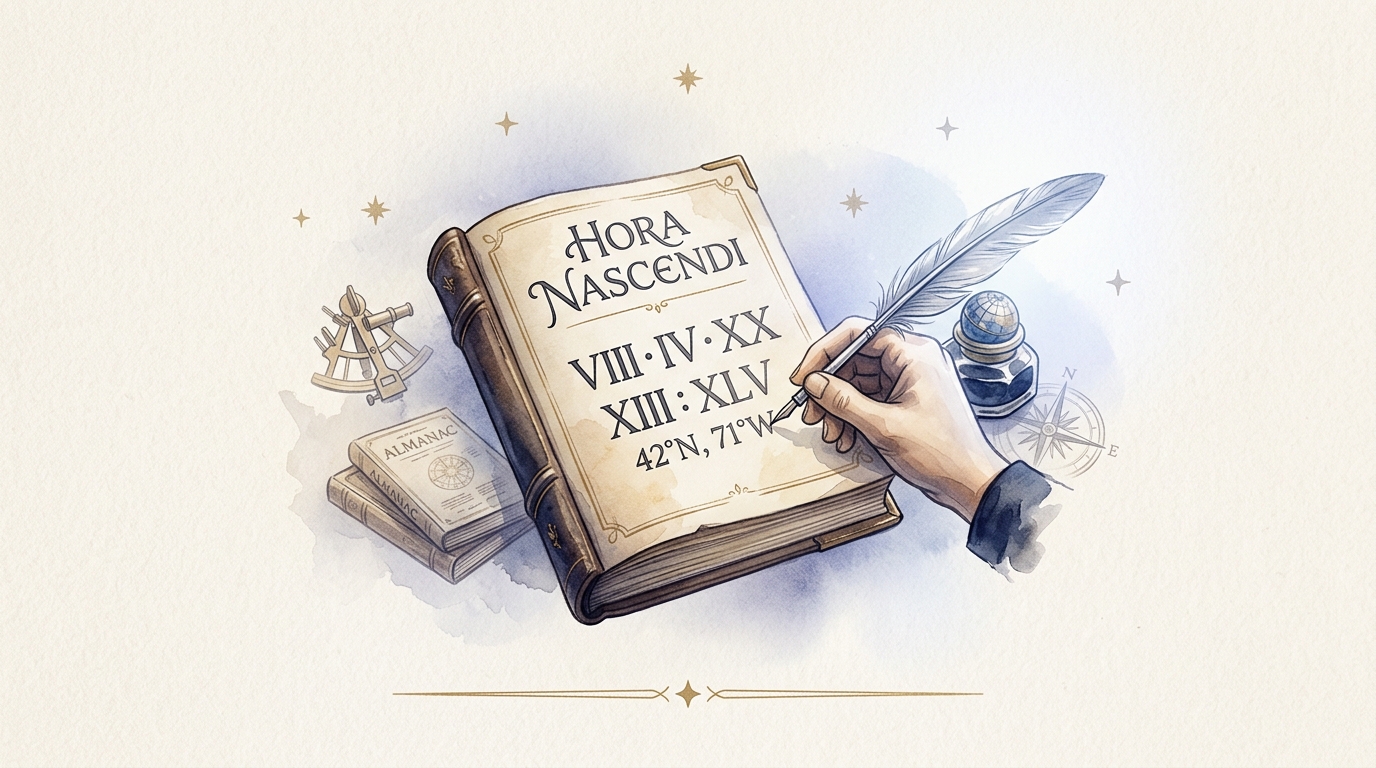
Before you generate a birth chart online, you need three essential pieces of information: date of birth, exact time of birth, and place of birth. These details determine where the planets were positioned and how the chart is divided into houses. The date gives the planetary positions by day, the time sets the ascendant and house structure, and the place locates the chart on the Earth. If any of these are off, the chart may still be useful, but some parts will be less precise.
The most obvious requirement is the birth date, because it places the chart in the correct day and year. Yet the date alone does not provide a complete chart, especially if you want the rising sign and houses. The exact birth time is often the most sensitive detail, since even a small difference can change the ascendant or shift several house cusps. The birthplace matters because charts are calculated relative to latitude and longitude, not just local clock time. In other words, astrology is not working from a generic template; it is working from a specific coordinate in space and time.
If you are using a free calculator, it may ask for additional settings such as time zone, house system, zodiac system, or chart style. These settings can affect how the chart is displayed and interpreted. For beginners, the main thing is to enter the known facts accurately and choose a standard setting unless you have a reason to do otherwise. If you are unsure about some details, it is better to acknowledge uncertainty than to guess. Astrology becomes less useful when the data is treated casually.
It is also worth considering privacy before entering sensitive information into any online tool. Birth data is personal, and different sites handle it differently. Some calculators only generate the chart and do not require a permanent account. Others may ask for email registration or keep your saved readings. If you care about privacy, choose a service that makes data use clear and allows you to calculate without unnecessary sharing.
| Birth detail | What it affects | Why it matters |
|---|---|---|
| Date of birth | Planetary sign positions | Determines which signs the planets occupied on that day |
| Exact time of birth | Ascendant, houses, Moon degree, fast-moving points | Can change the rising sign and the entire house layout |
| Place of birth | Local chart angles and house cusps | Anchors the chart to the correct location on Earth |
Why exact birth time matters so much
Exact birth time matters because the Earth is rotating constantly, which means the chart angles move quickly. The rising sign changes approximately every two hours, and in some cases the degree can shift enough to alter interpretations even when the sign remains the same. Houses can also change substantially from one time to the next, especially for planets near the horizon or midheaven. If you are studying personality, career themes, family dynamics, or relationship patterns, the house system is often central to the reading.
This is why people sometimes get conflicting chart results when they enter a rough time instead of an exact one. A chart generated at 8:10 a.m. may differ meaningfully from one cast at 8:45 a.m. Even a small correction can move the Moon to another house or change whether a planet is angular. For beginner use, the chart may still be directionally helpful, but it should be treated cautiously if the time is uncertain. Precision is not everything in astrology, but it matters more than many people realize.
If you do not know your time of birth, you can still work with your chart in a limited way. Many calculators can generate a noon chart or a chart without house emphasis, which lets you study planetary signs while treating house placement as provisional. Some astrologers also use birth time rectification, a technique for estimating a likely time from life events, though that is more advanced and not always necessary at the beginning. The main point is that an unknown time does not make astrology impossible; it simply limits what can be read confidently.
How to Create a Birth Chart Online Step by Step
Creating a birth chart online is usually simple, but the simplicity can hide important choices. The basic process is to find a calculator, enter your birth details, choose the chart style or astrology system if needed, and generate the result. Once you have the chart, the real work begins: checking what the symbols mean and deciding where to start reading. If you use the process carefully, you can get a chart that is both technically useful and psychologically meaningful.
The first step is to choose a calculator that is transparent about settings. A good tool should show the date, time zone, location, zodiac system, and house system it is using. It should also make the chart wheel easy to read and provide a list of placements or interpretations. If a calculator seems overly vague about what it is doing, that is not ideal, because hidden settings can change the result. Especially for beginners, clarity matters more than novelty.
Next, enter your birth details carefully. Double-check spelling for the birthplace, confirm whether the time is AM or PM, and pay attention to the time zone if you are using a site that does not automatically detect it. If you were born in a region with daylight saving time, the tool should adjust for that correctly, but it is still wise to verify. These details may seem technical, yet they shape the chart more than style preferences do. Accuracy at the input stage prevents confusion later.
Once the chart appears, resist the urge to interpret everything at once. Start with the big three: Sun, Moon, and rising sign. Then move to the chart ruler, the personal planets, the houses, and finally the aspects. This order is practical because it moves from identity and tone to specific life patterns. A chart can look crowded, but a step-by-step reading method makes it manageable.
Step 1: Choose a reliable calculator
Not all online calculators are equally transparent, and not all are built for the same purpose. Some are designed for quick curiosity, while others give more advanced options for sign systems, house systems, and chart styles. For beginners, the best calculator is the one that makes the chart accurate, readable, and easy to revisit. Reliability is not just about the visual quality of the page; it is about whether the generated chart is consistent and clearly labeled.
When assessing a tool, look for a few practical qualities. It should let you input exact birth data, display the chart in a clear wheel or table format, and offer a written breakdown of the placements. It should also identify the zodiac system in use, because tropical and Vedic charts are not interchangeable. If the tool offers interpretive text, use it as a starting point rather than an authority. Online astrology is most useful when it supports your own reading instead of replacing it.
- Check whether the calculator shows the house system and zodiac system it uses.
- Make sure the birthplace can be entered accurately, especially for smaller towns or cities with similar names.
- Prefer a chart that lists degrees, not only signs, because degree position adds important nuance.
- If you plan to revisit the chart later, choose a tool that lets you save or reopen it easily.
Step 2: Enter your birth information carefully
The most common point of failure is not the calculator itself but the birth data. A wrong hour, a missed time zone, or a typo in the city name can change the chart in ways that are not obvious at first glance. Because the chart is symbolic, beginners sometimes underestimate the importance of technical accuracy. Yet astrology depends on the exact relationship between the birth moment and geographic location, so input quality matters.
If you know the exact time from a birth certificate, hospital record, or family source, use that. If you only know a general range, be honest about the uncertainty. Some tools let you note that the time is approximate, which is much better than treating it as exact. If you are entering a birthplace that has changed names or has multiple transliterations, compare the result against a known city listing or geo search. A well-entered chart is already more trustworthy than a guessed one.
Step 3: Choose the chart settings you want
Many calculators let you customize how the chart is displayed. You may be able to choose a tropical or Vedic zodiac, a specific house system, a wheel layout, or a North Indian or South Indian chart format. These settings do not just affect appearance; they can affect interpretation. For beginners, it is usually best to start with one standard setting and stay consistent while learning. Otherwise you may compare charts that are not really speaking the same language.
If you are not sure what to choose, start with the system that matches the article or reading you plan to study. Tropical astrology is most common in Western online tools, while Vedic astrology uses sidereal calculations and a different interpretive frame. Wheel charts are often more intuitive for Western readers, while square formats may be more familiar in Vedic contexts. The best setting is the one that helps you read accurately without confusion.
Step 4: Review the chart output before interpreting
Once the chart is generated, take a moment to look at the basic structure before reading the text. Identify the Sun, Moon, rising sign, and the positions of Mercury, Venus, and Mars. Notice whether many planets cluster in one area or spread evenly across the wheel. Check whether any planets sit near the ascendant, midheaven, descendant, or IC, because angular planets often carry extra weight. This review stage gives you a first impression of the chart’s emphasis.
You do not need to understand every symbol immediately. What matters is building orientation. Reading a chart is less like decoding a single sentence and more like learning to notice recurring patterns in a complex map. The more often you look, the more the chart begins to organize itself into themes. That is why a good online calculator should be easy to return to repeatedly, not just once.
How to Read the Chart Layout: Signs, Houses, Planets, and Aspects
Once you have created a birth chart online, the next challenge is reading the layout without feeling overwhelmed. A natal chart is not meant to be read from left to right like a paragraph. It is a symbolic structure with multiple layers happening at once. The sign tells you the style of expression, the house tells you the life area, the planet tells you the function or drive, and the aspect tells you how different parts of the chart cooperate or conflict. Once you understand these four layers, the chart becomes much easier to approach.
Beginners often start by reading the sign alone and stop there, but that gives only a partial picture. For example, Mars in Cancer is not simply “soft” or “angry in a watery way.” Its meaning changes if it is in the 7th house, conjunct the Moon, or squared by Saturn. The chart layout is a system of relationships, not isolated labels. This is why the most useful reading order matters so much. A placement only becomes intelligible when you see what role it is playing.
Houses show where the energy tends to be lived out. Signs show how it tends to operate. Planets show what part of the psyche or life process is activated. Aspects show whether those parts work smoothly or need negotiation. This means that a birth chart online is not a list of personality traits, but a field of patterns. That is a more subtle and more useful way to understand astrology.
It is also important to remember that chart layout can vary slightly depending on the calculator. Some charts are wheel-based, with the zodiac arranged in a circle and houses drawn as slices. Others use tables or square systems that display the same data differently. The information is the same, but the visual organization changes the reading experience. If one chart style feels confusing, another may be easier to use.
| Chart layer | What it describes | Beginner reading question |
|---|---|---|
| Planet | A function, impulse, or psychological drive | What part of the person is being activated? |
| Sign | The style, tone, or manner of expression | How does this energy tend to behave? |
| House | The life area or sphere of experience | Where is this energy lived out? |
| Aspect | Relationship between two chart points | Does this part of the chart flow, conflict, or demand adjustment? |
Reading signs without flattening them
Signs are often treated as shorthand personality traits, but that approach can be too crude. A sign is more like a symbolic style of operation. Aries tends to move directly, Cancer tends to protect, Virgo tends to refine, and Aquarius tends to distinguish itself through ideas or principles. These are not fixed behaviors so much as ways of handling life energy. The same sign can look different depending on the planet it modifies and the house it occupies.
For example, Venus in Taurus and Mars in Taurus are both in the same sign, but they express very different functions. Venus may describe what a person values, how they attract, and how they seek pleasure or harmony. Mars may describe how they act, assert themselves, or pursue goals. The sign gives both planets a similar style, but the planet changes the role. This is why sign-only astrology easily becomes simplistic.
Reading houses as life arenas
Houses show the context in which a planet operates. A planet in the 1st house is often visible and strongly woven into identity. The same planet in the 4th house may be expressed more privately through family, home, or inner foundations. A planet in the 10th house may connect to public life, reputation, or vocational direction. The house is not the meaning itself; it is the territory where the meaning unfolds.
Beginners often ask whether a house is “good” or “bad.” That is not the most useful question. A house describes a type of life experience, and every house can be experienced constructively or with friction. The 8th house, for instance, is associated with deep bonding, shared resources, vulnerability, and transformation. It can bring profound psychological insight, but it can also intensify fears of loss or control. The real question is not whether a house is lucky, but how consciously it is handled.
Reading aspects as internal conversations
Aspects describe how planets relate to one another. Some aspects are easy and cooperative, while others create tension, urgency, or friction that can become productive when handled well. A trine may suggest an easy flow between two functions, while a square may show internal conflict that pushes growth through effort. A conjunction blends planets together so strongly that they may act as one combined principle. An opposition often creates awareness through polarity and relationship dynamics.
Aspects are especially useful because they show how the chart works internally. Someone may have a brilliant Mercury, but if Mercury is square Saturn, their thinking may be cautious, self-critical, or highly disciplined. Someone may have a warm Venus, but if Venus is opposed by Pluto, relationships may involve intensity, power dynamics, or a need for deep emotional honesty. This is why aspects are not just technical details. They are the difference between a flat chart and a living one.
| Aspect | Core meaning | How it often feels | Common expression |
|---|---|---|---|
| Conjunction | Fusion of energies | Intense, concentrated, hard to separate | A strong combined drive or identity theme |
| Sextile | Opportunity and cooperation | Open, workable, encouraging | Skills that develop through use |
| Square | Tension and challenge | Pressured, conflicted, motivating | Growth through friction and problem-solving |
| Trine | Ease and natural flow | Smooth, familiar, supportive | A talent that may need conscious activation |
| Opposition | Polarity and awareness | Split, relational, balancing | Learning through tension with others or between needs |
How to Interpret the Big Three First: Sun, Moon, and Rising Sign
If you are new to astrology, the most sensible place to start is the big three: Sun, Moon, and rising sign. These three placements create the strongest immediate sense of identity in most beginner readings because they describe different layers of the self. The Sun is the core identity and life force, the Moon is emotional life and instinctive comfort, and the rising sign is the outward style, first impression, and orientation to the world. Reading them together gives you a usable overview before you dive into the rest of the chart.
Many people overvalue the Sun sign because it is the most familiar. Yet the Sun is only one component of the chart. Someone may have a bright, direct Sun but a cautious Moon and a reserved rising sign, which creates a far more layered personality than the Sun alone suggests. The rising sign is often what others notice first, while the Moon is what becomes visible in close relationships or private settings. When you compare all three, you begin to see the chart as a living whole rather than a single-label identity.
The order matters. The Sun tells you what the person is trying to become conscious of. The Moon tells you what helps them feel safe, soothed, or regulated. The rising sign tells you how they instinctively approach new situations and how the chart is structured from the outside in. If you read the big three carefully, you can already understand a surprising amount about the person’s style, rhythms, and core tensions.
These placements also help you interpret the rest of the chart. The sign of the rising sign becomes the chart’s starting point and shapes the house system. The Sun’s house shows where identity seeks expression. The Moon’s house shows where comfort and instinct are most active. Once you know these placements, the rest of the chart is easier to organize.
The Sun: identity, vitality, and purpose
The Sun represents the organizing center of the chart. It describes where the person tends to seek coherence, confidence, and a sense of “I am.” Psychologically, it is not just ego in a shallow sense. It points to the principle of visible identity, conscious purpose, and the life force that wants to express itself clearly. A Sun in Leo may look proud or creative, but the deeper theme is often the need to radiate in a way that feels authentic. A Sun in Virgo may seek usefulness, precision, or discernment as a route to selfhood.
In a mature expression, the Sun tends to show clarity, self-possession, and a stable center of gravity. The person knows what matters to them and can move toward it with conviction. In a more difficult expression, the Sun may swing toward over-identification, defensiveness, or the need to prove itself constantly. This often happens when the Sun is under pressure from heavy aspects or when a person’s environment discourages self-expression. The sign and house both matter here, because a Sun in the 12th house may express identity more privately than a Sun on the ascendant or midheaven.
For example, a Taurus Sun in the 2nd house may express identity through building security, taste, and tangible competence. The same Taurus Sun in the 9th house may seek meaning through philosophy, travel, or a steady relationship with truth. The symbol stays Taurus, but the stage changes. That is why isolated sign interpretation can only go so far.
The Moon: emotional needs, habits, and internal safety
The Moon shows what the psyche needs in order to feel settled. It describes instinctive reactions, memory, nurturing patterns, and the emotional climate a person carries inside. It is often less deliberate than the Sun, which is why people can recognize their Moon sign most clearly under stress, in intimacy, or when routines break down. The Moon reveals what soothes, what unsettles, and what feels familiar even if it is not always consciously chosen.
In a mature form, the Moon can indicate strong emotional intelligence, empathy, self-care, and the ability to recognize patterns early. In a difficult form, it may show moodiness, overreaction, dependency, or the tendency to fall back into familiar habits that no longer serve. A Moon in Cancer may be deeply caring and protective, but in a more distorted state it may retreat into defensiveness or emotional overattachment. A Moon in Aquarius may need space and perspective, but in a harder expression it may detach too quickly from feeling.
The house placement is especially revealing for the Moon. A Moon in the 4th house may find emotional security through home, ancestry, and private nesting. A Moon in the 10th house may tie emotional worth to public achievement or responsibility. A Moon in the 7th house may need relational mirroring to feel alive and seen. Once you see where the Moon lives, you understand more about what kind of environment the person needs to function well.
The rising sign: style, threshold, and first response
The rising sign, or ascendant, is often described as the face a person shows to the world. That is helpful, but it is not the whole story. The ascendant is also the chart’s threshold: the way a person meets life before self-consciousness fully kicks in. It describes instinctive style, physical demeanor, and the lens through which the entire chart is organized. Many people experience their rising sign as a kind of default mode that activates automatically in new situations.
In a mature expression, the rising sign becomes a flexible and coherent way of engaging life. The person can use the rising sign as an interface without becoming trapped in it. In a difficult expression, the ascendant can become overperformed or overdefended. Someone with Capricorn rising may appear composed and controlled even when they are anxious inside. Someone with Gemini rising may appear quick, curious, or witty while struggling to settle into deeper feelings. The rising sign is not a mask in the fake sense; it is more like an adaptive entry point.
The ruler of the ascendant matters too. If Aries rises, Mars becomes especially important. If Taurus rises, Venus takes on more weight. This ruler often describes where life energy goes and how the person organizes effort. Beginners often overlook this, but it can be one of the most informative ways to deepen a chart reading.
| Big Three placement | Core function | Mature expression | Challenging expression |
|---|---|---|---|
| Sun | Identity and conscious purpose | Clear direction, self-respect, creative vitality | Ego defensiveness, overcompensation, identity strain |
| Moon | Emotional needs and habits | Self-soothing, emotional awareness, responsiveness | Mood reactivity, dependency, avoidance of discomfort |
| Rising sign | First response and outer style | Adaptable presence, clear entry into life | Overidentification with presentation, defensive persona |
How Planetary Placements Shape Personality, Strengths, and Challenges
After the big three, the next most useful layer is the planets themselves. In a birth chart online, the planets show the active functions that shape personality and behavior. Mercury describes thinking and communication, Venus describes attraction and value, Mars describes drive and assertion, Jupiter describes growth and confidence, Saturn describes structure and responsibility, Uranus describes change and independence, Neptune describes imagination and sensitivity, and Pluto describes depth, intensity, and transformation. These are not isolated traits; they are living functions that interact across the chart.
One reason planetary interpretation matters so much is that it reveals how a person handles common human tasks. How do they think under pressure? How do they choose what they want? How do they fight for something? How do they respond to limit, hope, change, or vulnerability? The planets answer these questions by showing the style of each impulse. A strong Mercury may support learning and expression, while a stressed Saturn-Mercury aspect may create caution, self-editing, or discipline. Neither is inherently better or worse. The context determines how the function is lived.
For beginners, it helps to read planets in layers. Start with the sign for style, the house for context, and aspects for modification. Then compare the planet to the chart ruler and to the Sun and Moon. This prevents overreading a single placement in isolation. A Mars in Libra does not mean a person is passive; it may mean they assert through negotiation, fairness, or relational awareness. A Venus in Scorpio does not automatically mean jealousy; it may mean emotional depth, intensity, and a need for trust in attachment.
As you study planetary placements, look for repeated themes. If Mercury, Venus, and the ascendant ruler all point toward water signs or 8th-house emphasis, the chart may be highly sensitive, intuitive, and psychologically perceptive. If several placements emphasize fire and angular houses, the person may be more direct, expressive, and action-oriented. Repetition is often more informative than a single standout symbol.
Personal planets: Mercury, Venus, and Mars
Mercury shows how information moves through the mind. It describes learning style, language habits, curiosity, and the way a person connects ideas. In a mature expression, Mercury is adaptable, alert, and clear. In a difficult expression, it can become scattered, anxious, overly analytical, or verbally defensive. The sign and house reveal whether thinking is abstract, practical, emotional, strategic, or inventive, while aspects show whether the mind is supported or under pressure.
Venus describes what a person values, how they relate, and what creates harmony, beauty, or pleasure. It is not only about romance. It also shows taste, social ease, and the ability to receive. In a mature expression, Venus can create grace, diplomacy, and a refined sense of what feels worthwhile. In a challenging expression, it may struggle with approval-seeking, indulgence, underpricing oneself, or difficulty tolerating disharmony. Venus in earth signs often seeks consistency and material quality, while Venus in air signs may seek exchange, beauty of thought, or social resonance.
Mars is the function of action, assertion, and desire. It tells you how someone pursues goals, sets boundaries, and responds to resistance. In a mature form, Mars is direct, brave, and efficient. In a more difficult form, it can become impulsive, frustrated, avoidant, or combative. Mars in fixed signs may show persistence and tenacity, while Mars in mutable signs may adapt quickly but sometimes disperse energy. The house of Mars often reveals where a person feels the need to act decisively or defend their place.
Social and transpersonal planets: Jupiter, Saturn, Uranus, Neptune, and Pluto
Jupiter expands whatever it touches. It represents confidence, meaning, faith, opportunity, and the desire to grow. In the mature form, Jupiter can bring generosity, perspective, and a healthy appetite for learning. In the difficult form, it may overdo, overpromise, or assume that optimism alone is enough. Jupiter’s sign shows how growth is sought, while its house shows the field where confidence and risk-taking are most active. A Jupiter in the 6th house may seek growth through service or skill, whereas Jupiter in the 9th house often leans toward education, travel, or worldview expansion.
Saturn tends to show where life asks for responsibility, patience, and structure. It is often misunderstood as purely restrictive, but Saturn is more accurately the planet of reality-testing and consolidation. In a mature expression, it gives endurance, integrity, and the ability to build something lasting. In a difficult expression, it can manifest as fear, inhibition, perfectionism, or a sense of not being enough. Saturn aspects are especially important because they show where confidence has to be earned and where maturity may arrive through time and effort.
Uranus, Neptune, and Pluto often feel less personal at first, but they matter a great deal when emphasized. Uranus describes disruption, originality, independence, and the urge to break away from stale patterns. Neptune describes imagination, idealization, spirituality, diffusion, and sensitivity to the unseen. Pluto describes power, compulsion, intensity, breakdown, and regeneration. In a birth chart online, these planets often reveal the deeper currents that shape life over time. They do not always show up as obvious personality quirks, but they often define major developmental themes.
How to compare strengths and challenges without moralizing the chart
Astrology becomes much more useful when you stop treating “strong” placements as good and “hard” placements as bad. A chart with many trines may have natural flow, but it may also lack motivation to change. A chart with squares and oppositions may feel more demanding, but it can produce resilience, awareness, and problem-solving skill. The goal is not to rank placements; it is to understand how the psyche organizes itself.
A practical way to do this is to ask two questions for each planet. First, what is easy or natural here? Second, what is under pressure or development? For example, a Mercury-Saturn aspect may produce careful speech, serious thought, and technical competence, but it may also bring self-censorship or fear of being wrong. Both sides are true. Likewise, a Venus-Jupiter aspect may bring warmth and generosity, but it may also incline toward excess or indulgence. The chart is a field of trade-offs, not a moral scorecard.
| Planet | Core function | Mature expression | Challenging expression |
|---|---|---|---|
| Mercury | Thinking and communication | Clear, adaptive, articulate | Scattered, anxious, overly self-conscious |
| Venus | Value and relating | Balanced, receptive, socially attuned | Approval-seeking, indulgent, avoidant of conflict |
| Mars | Action and assertion | Focused, decisive, courageous | Impulsive, frustrated, combative or passive-aggressive |
| Saturn | Structure and maturity | Disciplined, grounded, dependable | Inhibited, fearful, harshly self-critical |
How Houses Change the Meaning of Each Planet Placement
Houses are one of the most important parts of a birth chart online because they connect symbolism to life context. A planet does not mean exactly the same thing in every house. The sign tells you how the planet behaves, but the house tells you where that behavior is most likely to play out. This is why two people can have the same planet in the same sign and still live it very differently. The house changes the terrain.
Many beginners focus on planets and signs while skipping houses, but that often leads to incomplete readings. A Venus in Libra in the 1st house may be socially graceful, visually aware, and strongly concerned with how she presents herself. The same Venus in the 6th house may express through daily routines, work environment, service, or the aesthetics of practical life. The energy is related, but the setting changes the experience. That is the basic logic of houses.
It also helps to read house placements through the lens of lived experience, not abstract symbolism alone. The 2nd house can relate to money and possessions, but more deeply it concerns self-worth and the ability to stabilize value. The 7th house is about partnership, but also about how one meets the “other” and learns through reflection. The 12th house is often linked to solitude or hidden material, yet it can also describe unconscious patterns, retreat, compassion, and processes that do not happen in public. When you move past simplistic keywords, the houses become much richer.
The house of a planet also changes how visible that planet is. Angular houses, especially the 1st, 4th, 7th, and 10th, tend to make a planet more prominent and noticeable. Succedent houses often stabilize and consolidate energy. Cadent houses may route it into learning, adaptation, service, or internal processing. That does not mean angular is always better; it simply means more immediately observable. A chart with many planets in one house may organize life around that house’s concerns, while a chart with spread-out planets may feel more distributed.
Angular, succedent, and cadent houses
Angular houses are the houses of initiation and visibility. They tend to activate life in direct, public, or unmistakable ways. A planet here often feels forceful or impossible to ignore. Succedent houses are about sustaining and building, often with practical momentum. Cadent houses are more transitional and mentally active, often involving learning, adjustment, or processes that prepare the person for the next phase. These distinctions are useful because they show why some placements feel loud and others feel subtle.
A Moon in the 1st house may be emotionally expressive and visibly responsive, while a Moon in the 6th house may process emotions through work, routine, or bodily regulation. A Saturn in the 10th house may carry visible responsibility and status pressure, while a Saturn in the 3rd house may show disciplined thinking or fear around communication. Neither is inherently more important, but each has a different mode of expression. When you know the house type, you can read the planet with more precision.
House themes beginners can use immediately
You do not need to memorize every house keyword on the first pass. Start with the life arenas most often discussed in practical astrology. The 1st house is self and presentation, the 2nd is resources and value, the 3rd is thinking and local environment, the 4th is home and roots, the 5th is creativity and pleasure, the 6th is work and habits, the 7th is partnership, the 8th is shared resources and transformation, the 9th is meaning and expansion, the 10th is career and public role, the 11th is community and future goals, and the 12th is retreat and unconscious material. This list is enough to begin reading almost any chart usefully.
A planet in a house often shows where energy is likely to be invested, where attention returns repeatedly, and where learning may happen through repetition. If your Mars is in the 6th house, for example, you may put a lot of drive into work systems, routines, or health-related effort. If your Venus is in the 11th house, you may find ease in friendships, networks, or group belonging. If your Saturn is in the 4th house, you may approach home, family, or private life with seriousness, duty, or a desire for stability. These are not deterministic outcomes, but they are strong patterns worth noticing.
| House theme | Core life area | How a planet here may show up |
|---|---|---|
| 1st house | Identity and immediate presence | Strong visibility, strong self-definition, direct impact on demeanor |
| 4th house | Home, roots, and inner foundation | Private needs, family patterns, inner security concerns |
| 7th house | Partnership and close one-to-one dynamics | Strong relational learning, projection, commitment themes |
| 10th house | Career, status, and public role | Visibility, achievement pressure, vocation or reputation focus |
How Aspects Modify the Chart and Create Tension or Ease
Aspects are the relationships between planets, and they are one of the clearest ways to see how a chart functions internally. If planets are the actors, aspects are the conversations among them. Some conversations are easy and cooperative, while others are tense, competitive, or full of negotiation. A birth chart online without aspect awareness often looks too neat or too flat, because the real drama of the chart lives in these connections.
Aspects matter because they show whether a planet can express itself directly or whether it must work through another function first. For example, a confident Jupiter may flow easily into the Sun if they are trine, strengthening optimism and self-belief. But if Jupiter squares Saturn, the person may swing between expansion and restraint, enthusiasm and doubt. The placement itself is not enough; the relationship between placements changes the story. This is why aspect interpretation is one of the most important steps after identifying planets and houses.
Not all aspects are equally strong in the same way. Conjunctions blend energies tightly, sometimes so tightly that it can be hard to separate them. Squares create stress that often becomes productive through effort. Trines can create natural ease, which may feel like talent but may also require conscious activation to avoid complacency. Oppositions often show polarity, projection, or a need to find balance between two valid but competing needs. Sextiles usually indicate opportunity or easy cooperation, though they still benefit from initiative.
Beginners sometimes assume an aspect is “bad” if it is tense. That is not a helpful reading. Difficult aspects often describe the most dynamic growth areas in a chart and can produce remarkable skill when handled with awareness. Easy aspects can also be underused because they do not force attention. In practice, the best interpretation asks: what is the function of the tension, and what does it need in order to become workable?
Major aspect types at a glance
When you use an online calculator, many charts show degrees and glyphs, but the aspect patterns can still be hard to read at first. A simple way to start is to identify the major aspect types and notice which planets are linked. Conjunctions often show dominant themes. Squares and oppositions often show recurring friction. Trines and sextiles often show natural skill or support. Once you learn these patterns, the chart becomes more readable even before you know every interpretive nuance.
It also helps to consider orb, which is the degree of distance between two planets. A tighter orb usually indicates a stronger aspect, though exact practice varies by astrologer and system. This is one reason different online calculators can look slightly different or highlight different aspects. If you are comparing tools, make sure they use comparable settings so you are not confusing an orb difference for an interpretive difference.
How aspects change the feel of a planet
Imagine a Venus in Libra that is trined by Jupiter. This may emphasize charm, social ease, aesthetic sensibility, and generosity in relationships. Now imagine the same Venus square Pluto. The person may still value beauty and connection, but those qualities might come with intensity, power dynamics, or a stronger need for emotional truth. The sign has not changed, but the chart’s conversation has. This is exactly why aspect work gives astrology its depth.
A Mars-Moon aspect is another good example. A harmonious aspect may support immediate emotional action and healthy instinctive responsiveness. A hard aspect may show reactivity, impatience, or a struggle to balance emotional vulnerability with anger or self-protection. Neither version means the person is “too emotional” or “too angry.” It means those functions are linked in a particular way. That link can become a skill, a stress point, or both.
Aspect reading order for beginners
If you are new, do not try to interpret every aspect at once. Start with aspects to the Sun, Moon, and chart ruler. Then look at conjunctions and major hard aspects, especially squares and oppositions, because they often shape the chart more clearly than minor details do. After that, notice trines and sextiles for natural support. This order keeps you from getting lost in secondary patterns before you understand the core ones.
You can also ask a simple practical question for each aspect: what two functions are being asked to cooperate? If the chart shows Mercury square Neptune, the question might be how thought interacts with imagination, uncertainty, or idealization. If Venus trine Saturn appears, the question might be how love, taste, and commitment support each other. This keeps the interpretation concrete and prevents it from drifting into vague symbolism. Good aspect reading is descriptive before it is mystical.
| Aspect type | What it tends to do | Interpretive clue |
|---|---|---|
| Conjunction | Combines functions into one strong theme | Look for blending, intensification, or fusion |
| Sextile | Creates opportunity and workable flow | Look for skills that respond well to initiative |
| Square | Creates pressure, conflict, and motivation | Look for tension that drives growth and decisions |
| Trine | Supports ease, confidence, and flow | Look for talent that may need purpose to fully activate |
| Opposition | Highlights polarity and relationship balance | Look for projection, negotiation, and integration |
Birth Chart Styles and Settings: Tropical vs Vedic, Wheel Styles, and Display Options
When you generate a birth chart online, the result is not just shaped by your birth data. It is also shaped by the astrological system and display settings chosen by the tool. This matters because astrology is not a single universal interface. Tropical Western astrology and Vedic astrology use different zodiac frameworks and sometimes different interpretive priorities. In addition, chart style options such as wheel format, table format, and language of labels can make the reading either clearer or harder to use.
The most common beginner confusion is assuming that all charts are essentially the same. They are not. A tropical chart and a sidereal chart can place planets in different signs. A wheel chart and a square chart present the same data in different visual languages. A calculator that defaults to one system may not match what another site is showing. If you are trying to compare readings across websites, you need to know which settings each site uses. Otherwise, it is easy to think the chart is inconsistent when the real issue is a difference in framework.
The good news is that you do not need to master every system before you begin. You just need to know what the tool is using and why. If you are interested in Western astrology, choose a calculator that defaults to tropical zodiac and a familiar house system. If you are exploring Vedic astrology, use a tool that clearly indicates sidereal calculations and the chart format you want. Clarity beats complexity. Start with a system that is easy to read and stay with it long enough to understand its logic.
Display options also affect interpretation more than people expect. Some chart wheels show symbols only, some add degree numbers, some include a table of aspects, and some highlight retrogrades or house cusps. The best setting is the one that helps you read the chart with the least strain. If you plan to learn astrology gradually, a simpler display is often better than a crowded one. The goal is not to impress yourself with data. The goal is to understand the pattern.
Tropical vs sidereal zodiac
Tropical astrology aligns the zodiac with the seasons, beginning at the vernal equinox. It is the foundation of most Western online birth chart calculators. In this system, the signs are tied to seasonal symbolism rather than the fixed positions of constellations. Sidereal astrology, often used in Vedic practice, adjusts the zodiac relative to star positions and therefore can place planets in different signs than a tropical chart would. Both systems are internally coherent, but they are not interchangeable.
For beginners, the important thing is not to decide which system is “right” in an abstract sense. It is to use the system that matches the reading tradition you want to study. If you compare a tropical and a sidereal chart for the same person, expect different sign placements and possibly different emphasis. That does not mean one is broken. It means the symbolic framework has shifted. Reading the chart well depends on understanding the system you are in.
Wheel charts, table views, and app-style displays
Wheel charts are the classic circular presentation most people associate with astrology. They are visually rich and good for seeing aspects, house divisions, and angular placements at a glance. Table views are often easier for beginners because they list signs, degrees, houses, and aspects in a simpler grid. App-style displays may prioritize quick reading, notifications, or short interpretations, which can be convenient but sometimes flatten the chart’s depth. Different display types serve different goals.
If you are learning, it can be helpful to use both a wheel and a table. The wheel helps you understand spatial relationships, while the table helps you verify exact placements. A mobile app may be useful for on-the-go reference, but a web-based chart often gives a fuller picture. If your goal is to interpret rather than just glance, choose a display that shows enough detail to support careful reading.
Customizable settings that actually matter
Not every chart setting has equal importance. Some settings are cosmetic, while others are interpretive. The most important ones are zodiac system, house system, location, time zone correction, and orb settings for aspects. Depending on the calculator, you may also be able to turn on or off asteroid points, nodes, or additional objects. Beginners usually do better by focusing on the main planets first and leaving extras for later.
- Use the same zodiac system each time you compare charts so the results stay meaningful.
- Keep the house system consistent while you are learning, especially if you are studying house placements.
- Prefer displays that show degree positions and aspects clearly, not only sign names.
- If you are overwhelmed, simplify the chart by hiding minor objects until the major placements are clear.
North Indian vs South Indian Chart Formats and What Changes in Interpretation
If you are exploring Vedic astrology, you will likely encounter North Indian and South Indian chart formats. These are not different charts in the sense of different birth data; they are different ways of displaying the same underlying information. The placements, once calculated, remain the same within the system, but the visual arrangement changes. For beginners, this can be confusing at first because the chart may look unfamiliar even when the symbolism is consistent.
The North Indian chart format typically uses a diamond-like structure where houses are fixed in the layout and signs move through the chart. The South Indian format usually presents signs in fixed positions, with houses and sign placements shown more explicitly in relation to the chart’s structure. One format is not inherently more accurate than the other. They are different visual conventions for organizing the same symbolic data. What matters is learning which format your chosen tool uses and how to read it consistently.
Because the chart style changes, beginners may think the interpretation changes more radically than it actually does. In reality, the core planetary sign placements and house relationships remain the basis for analysis. The visual reading path simply changes. Once you know where to look, both formats can be read clearly. The main challenge is getting comfortable with the map itself.
For those coming from Western astrology, the Vedic rasi chart may seem especially important because it often serves as the foundational chart. The rasi chart emphasizes the sign-based planetary structure and is central to many Vedic readings. If you use a birth chart online tool that offers both styles, you do not need to interpret both at once. Start with the one that matches your study goal and learn its logic before branching out. Too many systems at once can create noise instead of insight.
North Indian format: fixed houses, moving signs
The North Indian chart is often easier for people who like structure and symmetry. Since the houses stay fixed, the layout can make it easier to track where each sign has landed. This format is common in many Vedic astrology settings and can be very efficient once you understand the visual code. The downside for beginners is that the fixed-house structure can look abstract at first because the chart does not resemble a standard zodiac wheel.
In interpretation, the North Indian format does not change the meaning of a planet. It changes how quickly you can see the relationships. If you are reading a chart with multiple planets in one area, the North Indian style may make that concentration easier to notice. If you are studying house patterns, it can also be useful because the house grid remains stable. The best format is the one that helps you see the symbolism without confusion.
South Indian format: fixed signs, readable sign sequence
The South Indian chart fixes the signs in place and shows the planetary placements relative to those sign positions. Many readers find this more intuitive once they learn the sign layout, because it resembles a stable coordinate grid. If you are focused on sign-based placements, this format may feel clearer than the North Indian one. It is especially helpful when comparing multiple charts or moving quickly through planetary positions.
Again, the interpretive logic stays the same. A planet in a sign and house must still be read as a combination of role, style, and context. The difference is mainly visual. If you feel lost in one format, try the other. A chart style that reduces friction can make your first readings much more accurate simply because you will pay better attention.
How to Use Your Birth Chart for Self-Understanding and Practical Reflection
A birth chart online becomes most useful when it moves from curiosity into reflection. The value of the chart is not in labeling you, but in helping you observe patterns you may already live out automatically. A chart can reveal where you tend to overwork, avoid conflict, idealize others, seek approval, protect yourself, or keep returning to the same emotional script. That makes it a practical tool for self-understanding rather than a decorative one. The symbolism is only useful if it changes how you see yourself and your choices.
One of the strongest uses of a chart is to notice repetition. If your Sun, Moon, and rising sign all emphasize a particular element or mode, that theme may be a central lens in your life. If several planets are concentrated in one house, that area may carry more psychological weight than others. If your chart ruler is strongly aspected, the story of that planet may be especially important. The chart helps you identify what is already central, so you can stop misreading yourself through other people’s expectations.
Another useful application is to work with strengths and stress patterns separately. A chart often shows what comes naturally, but it also shows what requires attention. Someone with supportive Venus aspects may have genuine relational skill, but if Saturn is hard on the Moon, emotional self-protection may still be a lifelong challenge. Someone with a strong Mars may be effective in action but need to watch impatience or burnout. Self-understanding is not about assigning a label. It is about seeing where energy flows well and where it needs support.
You can also use the chart as a reflection prompt instead of a verdict. Ask what a placement describes in ordinary life. Where do I feel comfortable? Where do I become defensive? What kind of work lets me thrive? What kind of relationships pull out my habits? Which themes appear in family, career, and friendship? These questions make the chart active and concrete. The more specific the question, the more useful the answer.
Simple reflection prompts by placement
If you want to use your chart without getting overwhelmed, try one placement at a time. Begin with the Sun, Moon, and rising sign, then move to the chart ruler, then to one personal planet that feels especially noticeable. Reading the whole chart is a process, not a single event. The goal is to gather insight gradually and let it accumulate into a fuller picture.
- What does this placement make easy for me?
- Where does it create friction or self-consciousness?
- How does it show up in relationships or work?
- What would its mature expression look like in everyday life?
- What habit or assumption might it be asking me to notice?
Using the chart without overidentifying with it
A good chart reading should clarify, not trap. If you use astrology well, it should expand your language for experience rather than reduce you to a type. People are more flexible than any single placement. A difficult Mars aspect does not mean someone is always angry. A soft Moon does not mean someone is always gentle. Human beings adapt, learn, and change over time. The chart shows tendencies, not a prison.
That is why the most mature use of a birth chart online is reflective rather than fatalistic. You can notice patterns without treating them as destiny. You can recognize a vulnerability without turning it into an identity. You can identify strengths without becoming attached to a performance of those strengths. Astrology becomes genuinely useful when it increases agency, not when it replaces it.
Free Birth Chart Calculators vs Professional Readings: When Each Makes Sense
A free birth chart online calculator is often enough for learning the basics, especially if your goal is to generate a chart, identify your main placements, and begin reading them in a structured way. Free tools are excellent for accessibility, repetition, and experimentation. They let you compare settings, try different chart styles, and practice interpretation without committing to a paid service. For beginners, this is usually the best starting point because it makes learning low-pressure.
Professional readings can make sense when you want a deeper synthesis, a more personalized explanation, or help with complicated chart patterns. A skilled reader can see the chart as a whole, prioritize the most relevant placements, and connect symbolism to life circumstances in a way that software cannot. This is especially helpful if you have a difficult-to-read chart, an uncertain birth time, or a strong desire to understand a specific life issue. A human astrologer can also notice nuance that a generic report may miss.
That said, professional readings vary widely in quality. A good reading is not simply one with confident language or dramatic claims. It should be specific, contextual, and grounded in actual chart factors rather than generic statements. If you are considering a reading, it is wise to know what kind of astrology the reader practices and whether their style matches what you are looking for. Some readers focus on personality, others on timing, relationship dynamics, or vocational direction.
For many people, the most efficient path is to start with a free calculator, learn the chart structure, and then decide whether deeper guidance would help. This way, you are not outsourcing interpretation before you understand the basics. You can also use a calculator to prepare intelligent questions for a professional reading. That often makes the session more useful because you already know which placements are drawing your attention.
| Option | Best for | Strength | Limitation |
|---|---|---|---|
| Free calculator | Beginners, self-study, quick checks | Accessible, repeatable, good for learning | Interpretation may be generic or shallow |
| Mobile app reading | Quick reference, daily use | Convenient and portable | Can oversimplify or distract with notifications and short takes |
| Professional reading | Complex charts, specific questions, deeper synthesis | More nuanced and tailored | Varies greatly by reader and may cost money |
When a mobile app-based chart reading is useful
Mobile app-based readings are best for convenience and ongoing reference. If you want to check placements quickly, revisit your chart often, or receive short explanations on the move, an app can be very practical. Some apps also let you track transits or compare charts over time, which can be useful once you know the basics. The limitation is that app readings often emphasize speed over depth, so they are not always ideal for nuanced interpretation.
Think of an app as a pocket reference, not a complete teacher. It can remind you where your planets are and offer quick commentary, but it usually cannot synthesize the whole chart as effectively as a thoughtful manual reading. If you use an app, pair it with a more detailed chart view so you do not lose the structure behind the summary text. Convenience is helpful, but it should not replace understanding.
What a good professional reading does differently
A good astrologer does more than list placements. They identify patterns, weigh emphasis, and connect symbolism to the questions that matter most to you. They may notice that one hard aspect repeats across different life themes, or that a chart has a strong protective pattern that changes how a difficult placement should be read. A well-done reading feels specific because it is grounded in the chart as a whole. It should not sound like a generalized fortune cookie.
If you are considering a professional reading, ask whether the astrologer works from your exact birth data and whether they will explain their logic clearly. That matters because you want to learn from the reading, not just receive conclusions. The best readings leave you with a better framework for understanding your own chart. They do not create dependence. They increase literacy.
Common Mistakes When Using Online Birth Chart Tools
Even though a birth chart online tool is easy to use, beginners often make a few predictable mistakes. The most common one is assuming the first result is complete or self-explanatory. A chart is generated instantly, but reading it well takes some thought. Another common mistake is overvaluing one placement while ignoring the rest of the chart. Astrology is a pattern language, and pattern languages do not work through single symbols in isolation.
Another issue is treating all online interpretations as equally reliable. Some websites offer thoughtful and well-structured explanations, while others recycle generic text that could apply to almost anyone. If you rely too heavily on canned interpretations, you may think you understand the chart when you only understand a stereotype. It is much better to use online text as a guide and then test it against the actual chart structure. The chart should be the standard, not the marketing copy.
People also make mistakes by comparing charts generated with different systems and not noticing the settings. A tropical chart and a sidereal chart may both be valid within their own frameworks, but they will not match exactly. Likewise, house systems can change the interpretation of house placements. If you are learning, keep your variables controlled. Otherwise you will think astrology is inconsistent when the real issue is that your settings changed.
Finally, beginners sometimes forget that interpretation is contextual. A placement that looks difficult may be highly functional in the right environment. A placement that looks easy may go unnoticed or underused. The point is not to search for the “best” chart. The point is to understand how your chart works so you can meet it more consciously.
- Do not assume the Sun sign explains the whole chart.
- Do not ignore birth time accuracy if you want house or rising sign information.
- Do not compare tropical and sidereal results without noticing the system difference.
- Do not trust generic interpretations more than the actual chart structure.
- Do not read every placement in isolation; look for repeats and patterns.
What to Do If Your Birth Time Is Unknown or Uncertain
An unknown birth time does not make a birth chart online useless. It simply changes what can be read with confidence. Without a reliable time, the ascendant, house cusps, and some fast-moving points may be uncertain. That means you can still study sign placements and many planetary relationships, but you should be careful about house-based interpretations. In practice, this is still enough to learn a great deal.
If your time is only approximate, you can use the chart as a partial map while keeping key questions open. Some calculators allow noon charts, which are useful for studying planetary signs without overcommitting to houses. This can be a good way to begin if you are just exploring your chart or if family memory about the birth time is vague. You can also compare the time you do have against major life events to see whether the rising sign feels plausible, though that process can take time and should be approached cautiously.
Some readers use rectification to estimate a birth time from life history, physical appearance, or event timing. That can be valuable, but it is a more advanced practice and not necessary for a first reading. Beginners often do better by respecting uncertainty instead of forcing precision. A chart is most trustworthy when its limits are clearly acknowledged. Being honest about uncertainty is a sign of good interpretation, not weakness.
In many cases, the sign placements alone are still enough to identify major themes. For example, a strong emphasis on water signs may reveal a person who processes experience through feeling and memory, while a concentration of earth signs may point to practical, stabilizing priorities. Even without houses, the chart can show style, temperament, and relational tendencies. It just cannot specify the life arenas with the same precision.
How to read without a birth time
Begin with the Sun, Moon, Mercury, Venus, Mars, Jupiter, Saturn, Uranus, Neptune, and Pluto by sign. Notice element balance, modality balance, and repeated sign families. Then study any close aspects that are not house-dependent. You can learn a great deal from planetary dynamics alone. If the Moon’s exact degree is uncertain because of time, treat Moon-house conclusions with caution, but the Moon sign may still be usable in many cases if the birth time is reasonably close.
If you later discover an exact time, you can update the chart and check what changed. That comparison is often illuminating because it shows which parts of the chart were reliable all along and which were only provisional. The key is not to pretend more certainty than you have. Good astrology is careful with data.
How Accurate Online Birth Charts Are and What Affects Reliability
Online birth charts can be very accurate when the input data and calculation settings are correct. The mathematical calculation of planetary positions is not the weakest link in most modern tools. The more common problems are user input errors, unknown birth times, inconsistent settings, or overly simplified interpretations. In other words, the calculator itself is often more reliable than the way it is being used. That is encouraging, because it means you can get a very solid chart without complicated equipment.
The main factors affecting reliability are birth data quality, time zone accuracy, daylight saving corrections, birthplace selection, and the calculator’s chosen astrology system. If all of these are set correctly, the chart should be dependable for the framework it uses. Problems usually arise when one site defaults to tropical astrology while another uses sidereal, or when a time zone is entered incorrectly. If your chart results seem inconsistent, check the settings before assuming the chart is “wrong.”
Interpretation reliability is a separate issue from calculation reliability. A chart may be mathematically correct but read poorly if the source text is generic, exaggerated, or not contextualized. Some online descriptions sound authoritative because they are confident, but they lack nuance. A good interpretation acknowledges mixed expressions, chart modifiers, and the need to read the whole chart. That is especially important for beginners, who may otherwise mistake simplified text for genuine depth.
Another factor is how you yourself read the chart. If you focus only on the most dramatic symbol, you may miss the balancing factors that change the meaning. A difficult aspect can be softened by a strong supportive configuration elsewhere. A challenging house emphasis may be compensated by a stable chart ruler or a strong element balance. Reliability, in practice, comes from both accurate calculation and careful synthesis.
How to evaluate a chart calculator quickly
You do not need to test every site exhaustively to know whether it is worth using. Look for a few signs of care. The calculator should clearly explain what system it uses, allow precise birth data entry, and show enough chart detail to be interpreted responsibly. If it offers both visual and tabular outputs, that is helpful because you can verify the placements in two formats. A calculator that hides important settings or buries key assumptions is less ideal for serious learning.
It is also useful if the site makes it easy to read on mobile devices without losing clarity. Many people first explore astrology on a phone, so an interface that adapts well can make the learning process smoother. But even a good mobile app should not encourage passive consumption only. The best tools help you understand the chart, not just scroll through it.
Frequently Asked Questions
What is a birth chart?
A birth chart, or natal chart, is a map of the sky at the moment and place you were born. It shows the positions of the Sun, Moon, planets, houses, and aspects, which astrologers read as a symbolic pattern of personality, emotional needs, and life themes. It is not a personality test in the modern sense, but it functions as a framework for reflection and interpretation. In practical terms, it helps you see recurring tendencies more clearly.
For beginners, the chart is most useful when read as a structure rather than a set of labels. The Sun, Moon, and rising sign give you a first overview, while planets, houses, and aspects add depth. If you generate a birth chart online, you are looking at the same basic symbolic map in a digital format. The main difference is that the calculation happens instantly instead of manually.
How do I generate a birth chart online?
You generate a birth chart online by entering your date of birth, exact time of birth, and place of birth into a calculator. The tool then calculates the planetary positions and draws the chart wheel or table. If the site offers settings, choose the zodiac system and house system you want before generating the chart. Once the chart appears, review the big three and the planetary placements before diving into details.
The most important step is entering the information accurately. A wrong time or location can change the rising sign and houses, which affects interpretation significantly. If you are unsure about the time, use a chart method that clearly accommodates uncertainty. Start with a calculator that makes the chart easy to read rather than one that overwhelms you.
How important is exact birth time?
Exact birth time is very important if you want an accurate ascendant and house placements. The rising sign changes relatively quickly, and house cusps shift as the Earth rotates, so even small errors can affect the chart. The Moon can also move enough to matter in some contexts, depending on the time. If your birth time is off, the chart may still be useful, but some parts will be less reliable.
If you do not know the exact time, you can still work with sign placements and many planetary aspects. In that case, avoid making strong claims about houses or the rising sign. A noon chart or an uncertain-time chart can still teach you a lot about your symbolism. It just needs to be handled with more care.
What if I do not know my birth time?
If you do not know your birth time, you can still generate a partial chart and study the planetary signs, aspects, and likely repeating themes. Some calculators allow noon charts or charts marked as approximate, which are helpful for beginners. You should be cautious about the ascendant and house placements, because those depend heavily on the time. If you later find the time, you can update the chart and see what changes.
In some cases, astrologers use rectification to estimate a likely time based on life events, but that is an advanced process and not necessary for a first step. The main thing is not to guess casually. Being honest about uncertainty leads to more reliable interpretation than forcing precision that you do not actually have.
Can I customize the chart style or settings?
Yes, many birth chart online tools allow you to customize the style and settings. Common options include tropical versus Vedic zodiac, house system, wheel display, square display, degree labels, and sometimes North Indian or South Indian chart format. These settings matter because they change how the chart is calculated or displayed. If you are comparing results across websites, make sure the settings match.
For beginners, the best approach is to keep settings simple and consistent. Choose one system, learn its logic, and only then experiment with alternatives. That makes it easier to understand what changes are mathematical and what changes are visual. If you change everything at once, you may not know what you are actually comparing.
Which free birth chart websites are considered reliable?
A reliable free calculator is one that is transparent about its settings, accurate with birth data, and clear in how it presents the chart. It should show the system it uses, provide readable placements, and avoid misleading claims about certainty. Since many different sites can produce correct calculations, the most important issue is clarity and consistency rather than brand prestige alone. A good tool should help you learn, not just generate a pretty graphic.
If you are exploring options, compare a few calculators using the same birth data and settings. If the results match, that is a good sign. If they differ, check whether one site uses a different zodiac or house system. Free tools are often excellent, but the value lies in how well they explain what you are seeing.
Can I get a reading or interpretation after generating the chart?
Yes, many online tools offer a basic reading after you generate the chart. Some provide brief placement descriptions, while others give more structured summaries of the Sun, Moon, rising sign, houses, and aspects. These can be useful as a starting point, especially if you are new to astrology. They are most helpful when you already know the chart structure and can compare the text against the actual placement pattern.
For deeper interpretation, you may want a professional reading or a more detailed self-study process. Automated text is convenient, but it often lacks the nuance needed to synthesize the whole chart. A good reading should connect the pieces rather than treat each placement separately. That is where a human astrologer or a careful interpretive framework can add value.
Conclusion: The Simplest Next Step After Generating Your Chart
A birth chart online is most valuable when it moves from a curiosity object into a practical reading process. You do not need to understand every symbol on day one. You need a reliable chart, a clear order of interpretation, and the patience to read it as a system rather than a slogan. Start with the big three, then move to the chart ruler, the personal planets, the houses, and the major aspects. That sequence alone will take you much farther than random keyword searching ever could.
If you remember only one thing, let it be this: the chart is a set of relationships. A planet means one thing in one sign, another thing in another house, and something more complex again when aspects are involved. Once you begin to see the chart that way, astrology becomes less like a list of labels and more like a structured language of patterns. That is what makes it genuinely useful for self-understanding. It can show where your energy is easy, where it is pressured, and where it asks for conscious attention.
The simplest next step is to generate your chart, check that your birth details are accurate, and read just three placements before anything else: your Sun, Moon, and rising sign. Then look at one planet at a time and ask how its sign, house, and aspects change the meaning. If you want to see exactly where these placements fall in your own chart and compare the result against this step-by-step framework, you can calculate your natal chart by date of birth and begin exploring it with a more precise lens. The more carefully you read, the more your chart becomes a usable map rather than an abstract diagram.
Astrology works best when it is treated as a disciplined form of symbolic reflection. That means staying curious, staying precise, and staying open to nuance. A good chart does not tell you who you are in a fixed way. It helps you notice how you are organized, where you may be resisting yourself, and where your strengths already live. That is a strong place to begin, and it is often enough to start reading your life more intelligently.
Author
Selfscan