
Natal Chart Houses: What Each of the 12 Houses Means for Your Life
The natal chart houses meaning becomes much easier to understand once you stop treating the chart like a list of isolated keywords. Houses describe the life areas where astrology becomes concrete: where your energy is directed, where events tend to happen, and where you are likely to invest attention, effort, and meaning. If signs show style and planets show action, houses show the stage on which that action plays out. That simple framework makes the chart far more readable, especially for beginners who feel overwhelmed by symbols.
A house does not tell you everything by itself, but it does tell you where a planetary story is likely to land. Your birth chart may show ambition, intimacy, communication, or rest in very different ways depending on the house involved. That is why two people can share the same planet in the same sign and live it out differently. The chart wheel is not just about personality traits; it is a map of life departments, from identity and money to relationships, work, family, and inner healing.
This guide will give you a practical, beginner-friendly way to read the 12 houses without reducing them to vague buzzwords. You will learn what each house means, how houses differ from signs and planets, where the chart begins, why empty houses are not “nothing,” and how to read house rulers, oppositions, and stelliums. You will also get a simple workflow you can use on your own natal chart right away. The goal is not to make astrology more complicated, but to make it more legible.
If you have ever looked at your birth chart and thought, “I understand my sign, but what do the houses actually do?”, this article is meant to answer that question directly. By the end, you should be able to look at a chart and recognize which areas of life are emphasized, which are quieter, and how to interpret those patterns in a grounded way. The natal chart houses meaning is not abstract when you know how to read them. It becomes a practical lens for understanding your own life structure.
The most useful beginner rule is also the easiest to remember: signs = style, planets = action, houses = where it happens. That one sentence can prevent many common mistakes. Still, it is only the starting point, because house rulers, angles, house systems, and chart emphasis all add depth. We will move from the simple framework into the more precise layers so you can read your chart with more confidence and less guesswork.
What the 12 Houses Are in a Natal Chart
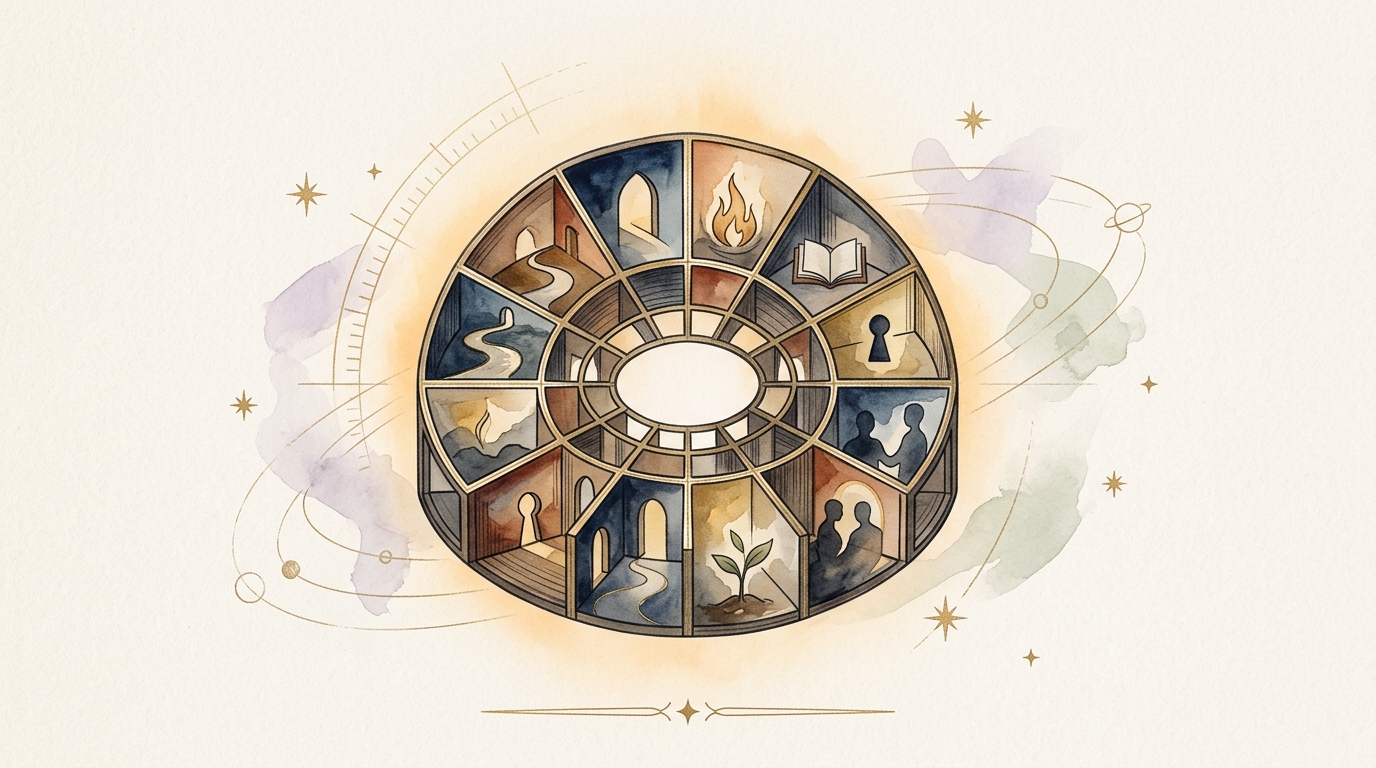
The 12 houses in a natal chart divide life into symbolic zones. Each house represents a different field of experience, and together they create a complete map of human concerns: identity, money, communication, home, pleasure, work, relationships, transformation, belief, career, community, and inner retreat. This does not mean that every house is equally active at every moment, but it does mean that the chart has a structure for understanding where different kinds of experience tend to gather. In practice, houses tell you which life department is being emphasized when a planet, angle, or ruling planet is involved.
A helpful way to think about houses is to imagine a house with 12 rooms. You do not live in all of them in the same way, and you do not decorate them all with the same objects. One room may be where you sleep, another where you work, another where you store things, and another where you host guests. Astrology uses that same architectural logic. Each house is a function, not just a label, and the chart’s occupants—planets—bring particular behaviors into those functions.
The houses are not zodiac signs, even though beginners often mix them up. Signs describe qualities such as cardinal, fixed, mutable; fire, earth, air, water; and the mode of expression. Houses describe areas of life and the circumstances through which the energy shows itself. A planet in a sign gives tone, but a planet in a house gives location. When you understand that distinction, the chart becomes less confusing and more useful. You can begin to read not only what you are like, but where your attention and life lessons tend to concentrate.
In a beginner reading, the houses are often the easiest place to start because they connect directly to lived reality. It is one thing to say that a person has Mars in Leo; it is another to say that Mars in Leo sits in the 10th house and therefore shapes career drive, public reputation, and ambition in a visible way. The house gives that planet an arena. Without the house, interpretation can stay too abstract.
The life areas represented by the 12-house framework
The 12-house system covers the whole arc of life experience, from the self to the collective, from visible identity to hidden unconscious material. Some houses are more personal, such as the 1st, 2nd, 4th, 5th, and 6th. Others are more relational or social, such as the 7th, 8th, and 11th. Some deal with public life, such as the 10th, while others move into interior territory, such as the 12th. This division is useful because it reminds you that life is not one flat category. Different parts of your chart speak to different levels of experience.
The chart also moves in cycles. The first six houses are often described as more personal and developmentally foundational, while the last six have a broader social or transpersonal quality. That is not a rigid rule, but it is a useful pattern. The first half of the chart tends to focus on building the individual self, and the second half tends to engage that self in relationship to others and the wider world. This movement gives the chart a narrative arc rather than a random set of placements.
When people ask what houses “mean,” the most honest answer is that they show the structure of experience. A strong house emphasis does not tell you exactly what will happen, but it does say where life repeatedly asks for attention. If you know how to read those patterns, you can understand why certain themes feel central while others remain quieter in the background. That is the real value of the house system: it turns symbolic language into an actual map of lived priorities.
| Astrology Component | What It Describes | Simple Example |
|---|---|---|
| Sign | Style, tone, quality, manner of expression | Venus in Virgo expresses affection carefully and thoughtfully |
| Planet | The action, drive, need, or principle involved | Venus shows love, attraction, values, and relating |
| House | Life area where the energy plays out | Venus in the 6th house may show affection through helping, service, or daily routines |
How Houses Differ from Zodiac Signs and Planets
The most common beginner confusion is to read a house as if it were a sign. That mistake can produce vague or misleading interpretations, because signs and houses answer different questions. Signs answer “how,” planets answer “what,” and houses answer “where.” If you keep that triad in mind, the chart becomes much easier to navigate. You can stop trying to make every symbol do the same job.
A sign colors the behavior. Aries, for example, may make a planet more direct, reactive, pioneering, or impatient. A planet is the function itself. Mars is assertion, effort, conflict, drive, and pursuit. A house is the life area. Mars in Aries in the 10th house is not just “strong Mars”; it suggests a person whose drive is expressed boldly and who may channel that energy into career, status, leadership, or public ambition. Each layer adds something different, and none of them should be collapsed into the others.
This distinction matters because a house can host very different versions of the same planet. Venus in the 2nd house may relate to income, possessions, self-worth, and values. Venus in the 7th house may emphasize partnership, negotiation, and attraction patterns. Venus in the 11th house may relate to friendships, social belonging, and group aesthetics. The planet is the same, but the environment changes the way it operates. That is why house placement is not a minor detail; it often changes the whole story.
Another useful way to separate the three is to ask a question of each. Sign: what style does this energy take? Planet: what kind of force is acting here? House: in which life area does it express itself? This method prevents overinterpretation and helps you stay specific. If you know the house, you know the context. If you know the sign, you know the expression. If you know the planet, you know the function. Put together, they create a clear symbolic sentence.
A simple framework for reading any placement
- Planet: What psychological function or drive is involved?
- Sign: What style, temperament, or method does it use?
- House: Where in life does it play out most obviously?
- Aspects: What other planets support, challenge, or reshape it?
A person with Mercury in Capricorn in the 3rd house may think practically, speak carefully, and focus on communication, learning, siblings, or short trips. The same Mercury in the 9th house might express through teaching, publishing, philosophy, or travel. The sign says how Mercury thinks; the house says where that thinking becomes a life theme. That is why houses are so powerful for self-reading: they turn abstract symbolism into recognizable experiences.
One more nuance matters here. Some houses feel more obvious because they align with external events, while others are subtler and more internal. The 10th house often shows up in public milestones; the 12th house may show up through hidden pressure, retreat, or inner work. Neither is more real than the other. They just operate on different levels, and that difference is one of the reasons the house system is so rich.
Where Houses Start: the Ascendant and the Chart Wheel
Every house system begins somewhere, and that starting point is the Ascendant, also called the Rising Sign. The Ascendant is the cusp of the 1st house, the point on the eastern horizon at the moment of birth in many chart systems. It is not just another placement; it establishes the chart’s orientation. Once you know the Ascendant, you can begin to read the rest of the houses in sequence around the wheel. This is why beginners are often told to find the Rising Sign first: it anchors everything else.
The 1st house is the beginning of the chart because it represents emergence, identity, embodiment, and the immediate way a person enters life. From there the houses proceed counterclockwise through the chart. The sequence matters because it organizes development. The early houses tend to focus on selfhood and material security, while the middle houses build creativity, work, and relationship, and the later houses expand into social structures, beliefs, and the inner world. The wheel is not random; it has a logic of unfolding.
The Ascendant also affects how the rest of the chart is read because it sets the house cusps, which are the boundaries between houses. In quadrant-based systems, the cusps can vary in size, and some houses may be larger or smaller than others. That means not every house gets the same amount of zodiac space. In practice, this is one reason why reading a chart is more nuanced than simply counting signs from Aries onward. The chart is a rotating map tied to the time and place of birth.
The Ascendant is often described as the outward interface between you and the world, but it is better understood as the first point of contact. It shapes first impressions, body language, instinctive adaptation, and the way you begin things. Because it starts the house system, it also tells you which sign colors each house cusp in your chart. That is why two charts with the same placements can still feel different if their Ascendants differ. The starting point changes the whole geometry.
How to find the chart beginning without getting lost
- Locate the Ascendant, usually marked as “ASC” on the left side of the chart wheel.
- Read the zodiac sign on that cusp as the Rising Sign.
- Treat that point as the start of the 1st house.
- Move counterclockwise through the wheel to identify the remaining houses.
- Note any planets sitting near house cusps, since they may influence adjacent houses depending on the system used.
The chart wheel is easier to use when you stop seeing it as a flat picture and start reading it as a sequence. The Ascendant is the doorway, not just a label. Everything else is arranged in relation to that doorway. If the chart feels confusing at first, this is often because the reader has not yet oriented to the 1st house properly. Once that changes, the chart becomes much more intuitive.
House-by-House Meanings: The 1st Through 12th Houses
The heart of the natal chart houses meaning lies in the house-by-house framework. Each house represents a major field of life, but it is more useful to read them as processes than as static categories. A house shows where a person must build awareness, effort, and identity over time. It is not just a topic; it is an arena where habits, desires, fears, and development play out. Below is a detailed guide to each house with practical examples and mature-versus-challenging expressions.
| House | Core Life Area | Mature Expression | Challenging Expression |
|---|---|---|---|
| 1st | Identity, appearance, first impressions, embodiment | Self-possession, authentic presence, healthy initiative | Over-identification, defensiveness, reacting from ego |
| 2nd | Money, values, possessions, self-worth | Stable resources, grounded priorities, earned confidence | Scarcity fear, possessiveness, self-worth tied only to income |
| 3rd | Communication, learning, siblings, local environment | Clear expression, curiosity, adaptable thinking | Mental scattering, gossip, nervous overactivity |
| 4th | Home, family roots, private life, emotional foundation | Inner security, belonging, emotional nourishment | Family entanglement, retreat into the past, instability at home |
| 5th | Creativity, romance, joy, children, self-expression | Creative vitality, warm playfulness, sincere enjoyment | Need for constant attention, dramatization, risk-taking for validation |
| 6th | Work routines, health, service, habits, daily functioning | Competence, supportive routines, practical care | Overwork, perfectionism, anxiety about usefulness |
| 7th | Partnerships, marriage, contracts, one-to-one relating | Mutuality, honest exchange, relational maturity | Projection, dependency, conflict avoidance or fixation |
| 8th | Intimacy, shared resources, loss, transformation | Emotional depth, trust, resilience through change | Control issues, fear of vulnerability, crisis fixation |
| 9th | Beliefs, education, travel, philosophy, meaning | Open-minded wisdom, coherent worldview, learning through breadth | Dogmatism, superiority, restless searching without integration |
| 10th | Career, reputation, authority, public role | Purposeful contribution, credibility, visible competence | Status fixation, burnout, identity fused with achievement |
| 11th | Friends, groups, networks, goals, future vision | Belonging through shared ideals, collaborative contribution | Detachment, social anxiety, trying to fit in by abandoning self |
| 12th | Unconscious patterns, solitude, endings, spiritual surrender | Inner insight, compassion, restorative solitude | Escapism, self-undoing, hidden anxiety or confusion |
The first six houses: personal foundations
The 1st through 6th houses often describe the personal foundation of a life. They deal with identity, resources, communication, home, pleasure, and daily work. These are the areas where the self is built and stabilized. When a planet appears here, it tends to affect how a person organizes ordinary life, how they manage their body and time, and how they form habits. The symbolism is intimate because these houses speak to what keeps life functional on a day-to-day level.
For example, a strong 2nd house emphasis may indicate someone who spends much of life thinking about earning, saving, investing, or building self-worth. A strong 6th house emphasis may show someone who focuses on routines, health, craft, or being useful in practical ways. Neither house is glamorous in the superficial sense, but both are essential. They reveal how the person establishes stability and reliability.
The first six houses are also more directly connected to personal agency. They show how you establish yourself in the world before life requires you to negotiate with others at a deeper level. If these houses are heavily emphasized, the person may be very self-directed or highly focused on how life is managed at the individual level. Even then, the chart’s balance matters. A 6th-house person with strong 7th-house planets may still need partnership to fully integrate their routines.
The middle houses: relationship and social exchange
The 7th through 10th houses move the chart into more relational and public terrain. These houses describe how the self meets others, how intimacy and shared resources deepen experience, how broader beliefs are formed, and how public achievement becomes visible. This is the zone where personal identity is tested and refined through exchange with the outside world. The chart begins to show not just what you do alone, but what happens when you enter the social field.
The 7th house is especially important because it introduces the principle of “the other.” The 8th house deepens into trust and mutual entanglement. The 9th house widens the horizon beyond personal experience. The 10th house places the person in public view. Together, these houses explain how private identity becomes relational identity and then social identity. This is often where readers start to see the chart’s story as a sequence rather than a list.
The final houses: collective, hidden, and integrative themes
The 11th and 12th houses are often misunderstood because they move away from straightforward personal categories. The 11th house is about community, shared goals, networks, and future-oriented visions. The 12th house turns inward toward hidden material, solitude, endings, and what cannot be fully controlled. These are not “less practical” houses. They are simply less immediate. They describe how a person relates to collective systems and to the parts of life that lie beyond ordinary ego management.
If a chart emphasizes the final houses, the person may feel naturally drawn toward causes, communities, private reflection, healing, or periods of withdrawal. There can be a strong instinct to think beyond the self, but also a need to avoid losing the self altogether. In mature form, these houses support wisdom, perspective, and depth. In their difficult expression, they can become places where a person feels disconnected, overwhelmed, or unsure where they belong. Like the rest of the chart, they are best understood through context rather than stereotypes.
How to Read Each House in Real Life: Practical Examples and Themes
Reading houses in a real chart becomes easier when you stop treating them as abstractions and start asking what they look like in daily life. A house is not just a topic heading. It is a place where choices repeat, where habits accumulate, and where the person is often asked to develop a particular kind of competence. The following examples are deliberately concrete so you can move from symbolic meaning to lived manifestation. They also help you notice that the same house can operate differently depending on the planet, sign, and aspects involved.
The 1st house may show up in how someone enters a room, chooses clothing, handles confrontation, or manages self-presentation online. The 2nd house may appear in how they spend money, what they collect, and how secure they feel without external validation. The 4th house may be visible in home arrangements, family loyalty, or the need for a private sanctuary. These are not dramatic events every day, but they are repeated patterns that shape character over time. That is why houses are so closely tied to ordinary life.
A practical reading should also pay attention to timing. A house can be activated by transits, progressions, or major life events. A person may not always feel their 8th house intensely, for example, but a breakup, financial merge, inheritance issue, or psychological turning point can bring it to the foreground. This does not mean the house was inactive before. It means the symbolism has moved from background to foreground. Once you understand this, you can read houses as dynamic life territories rather than fixed personality labels.
Personal houses in everyday life
1st house: Imagine someone who instinctively takes the lead, changes their style often, and notices how others respond to their presence. Their body language may be direct, and they may prefer autonomy in how they start things. In mature form, the 1st house supports self-knowledge and confidence. In difficult form, it can become reactive, self-protective, or overly focused on image.
2nd house: A person may build comfort through savings, quality purchases, or a stable routine around food and money. They may be especially aware of what they own and what they consider valuable. When expressed well, this house creates grounded self-respect and practical resource management. When stressed, it can lead to fear of lack, overattachment to possessions, or tying self-worth to material status.
3rd house: This house often shows up in text messages, short errands, sibling dynamics, local travel, teaching, and curiosity. Someone with a strong 3rd house may need movement, conversation, or learning in order to feel mentally alive. The mature expression is clear, adaptable communication. The shadow can be scattered attention, gossip, or nervous overstimulation.
4th house: The home itself becomes symbolic here, whether through family heritage, childhood memory, or the emotional tone of private life. A person may feel deeply affected by the atmosphere in their home and may need a base that feels safe and restorative. Healthy 4th-house energy creates inner steadiness and belonging. Unhealthy expression can show as family entanglement, emotional withdrawal, or carrying the past too heavily into the present.
5th house: You often see this in hobbies, performance, dating, creative projects, and interactions with children. The person may need some form of play or self-expression to feel fully themselves. Mature 5th-house expression is generous creativity and sincere enjoyment. Difficult expression can become drama, validation-seeking, or taking unnecessary risks just to feel alive.
6th house: This house appears through schedules, work systems, health habits, and the urge to be useful. A person may become anxious when routines break down, or they may feel best when life is organized and their work has clear purpose. The mature form is skillful service and sustainable discipline. The difficult form is overwork, perfectionism, and a tendency to equate worth with productivity.
Relational and public houses in everyday life
7th house: This is where marriage, long-term partnership, contracts, and one-to-one interaction become central. A person with a strong 7th house may learn about themselves through others more than through solitude. The mature expression is cooperation, fairness, and mutual respect. The challenging side is projection, dependency, or making other people carry unresolved parts of the self.
8th house: Shared money, intimacy, grief, emotional merging, and deep transformation belong here. This house often feels more intense because it deals with what cannot be kept fully separate. In its mature form, it supports trust, psychological depth, and resilience through change. In its difficult form, it can show control struggles, secrecy, fear of vulnerability, or a tendency to get stuck in crises.
9th house: Education, travel, religion, philosophy, law, and worldview development all connect here. A strong 9th house may belong to someone who needs meaning, breadth, and perspective. Mature expression includes wisdom, cultural curiosity, and the ability to synthesize experience into a coherent belief system. Difficult expression can become dogmatism, preachiness, or endless searching without integration.
10th house: Career, public reputation, authority, and achievement are central. A person with emphasis here may feel a need to build something visible or to be known for competence. Mature 10th-house expression is responsible leadership and meaningful contribution. The shadow can be burnout, obsession with status, or becoming so identified with success that private life disappears.
11th house: Friends, community, social networks, and future goals often matter deeply here. This house can show how someone contributes to groups and what kind of belonging they seek outside the family. In mature form, it supports collaboration and shared ideals. In difficult form, it can show detachment, social anxiety, or adapting to a group so much that the person loses their unique voice.
12th house: The final house often manifests in solitude, hidden fears, spiritual retreat, behind-the-scenes work, or unconscious habits. A person may not always be aware of the 12th house until they face endings, isolation, or invisible pressure. Its mature expression can be compassionate, reflective, and healing. Its difficult expression can look like avoidance, self-undoing, or confusion about one’s own motives.
How to notice a house in real life without forcing symbolism
- Look for repeated patterns, not one-off events. A house is about what keeps showing up over time.
- Notice where attention naturally goes when life is calm versus stressed.
- Track which topics feel easy, which feel demanding, and which feel strangely important.
- Check whether the house contains planets, and then read the sign and aspects for tone.
- Do not force every life event into a house meaning; look for symbolic fit rather than literal proof.
Real-life reading gets stronger when you move between concrete examples and symbolic principles. If you can describe how the 4th house feels in an actual household, or how the 10th house shows up in a work week, you are reading the chart in a grounded way. That is the level at which astrology becomes useful rather than decorative. The aim is not to memorize keywords; it is to recognize recurring life patterns through symbol.
Empty Houses: What They Mean and Why They Are Not Nothing
One of the biggest beginner worries is seeing an empty house and assuming it means that area of life does not matter. That interpretation is too literal and usually misleading. An empty house simply means no natal planets are placed there. It does not mean the house is inactive, unimportant, or doomed to stay quiet forever. In fact, many people have several empty houses and still experience those life areas in vivid, meaningful ways.
An empty house still has a sign on its cusp, a ruler, and a relationship to the opposite house. Those three factors keep it alive. If your 7th house is empty, for example, relationship themes still exist because the house has a sign and a ruling planet. If that ruler is strong in another house, it may show where partnership concerns get expressed. The absence of planets simply means the house is not carrying natal planetary concentration. It does not mean there is no story there.
This is an important distinction because many beginners think that only occupied houses matter. In reality, an empty house can sometimes feel easier to handle because it is less internally crowded. It may function in a more straightforward way, or it may be activated mainly by transits and the condition of its ruler. The challenge is not absence; the challenge is misreading absence as emptiness in the existential sense. Astrology does not work that way.
How to interpret an empty house properly
Start with the house cusp sign. The sign on the cusp tells you the style the house uses. For instance, if the 5th house is in Aquarius, creativity, romance, or self-expression may have a more experimental or unconventional tone even if no planet occupies the house. Then find the ruler of Aquarius, which is traditionally Saturn and modernly also Uranus depending on your approach. That ruling planet will show where the house’s energy tends to operate in the chart. This is often the single most useful step beginners miss.
Next, check the opposite house because polarities matter. The 5th and 11th houses, for example, relate to personal creativity versus collective belonging. If one side is empty but strongly emphasized by its ruler or transit, the opposite house can tell you how the theme is balanced or negotiated. This does not mean one house cancels the other. It means the chart creates a conversation between them. Empty houses become more intelligible when you read them as part of a relational pair.
A person with empty 10th and 11th houses may still have a highly active career and social life if the rulers of those houses are prominent elsewhere. Someone with an empty 2nd house may still care intensely about money, but may manage it through the ruler’s placement rather than through a direct concentration of planets. In other words, absence in the house does not equal absence in life. It often means the theme is distributed elsewhere in the chart.
What beginners often misunderstand about empty houses
- They think no planets means no theme. In reality, the house ruler still activates the area.
- They assume empty houses are easy or boring. Some are simple, but many are deeply important through rulership.
- They overlook transits, which can temporarily spotlight an empty house.
- They forget that the opposite house often explains the balance of the theme.
If you are learning the chart, resist the temptation to rank houses by how crowded they are. A house with no planets may still be a major life arena, especially if it rules the Ascendant, contains the Sun’s opposite polarity, or is tied to an angular ruler. The deeper lesson is that astrology is relational, not literalistic. The chart speaks through structure, not just occupancy.
Stelliums and Heavy House Emphasis: When One Area of Life Stands Out
A stellium in a house occurs when several planets gather in the same house, creating concentrated attention and symbolic weight in that area of life. This does not automatically make the house “better” or “harder,” but it does make it louder. The person may return again and again to the concerns of that house, because multiple planetary functions are working in the same territory. The result can be a strong talent, a repetitive challenge, or both at once.
For example, a 10th-house stellium may indicate a life strongly organized around career, visibility, responsibility, or achievement. A 4th-house stellium may suggest a person whose identity is deeply shaped by family, home, memory, or private emotional life. A 7th-house stellium can make partnership central to self-development, while a 12th-house stellium may create rich inner life but also periodic overwhelm or withdrawal. The house becomes a focal point because many planetary voices are speaking there at once.
It is important not to flatten a stellium into a stereotype. A cluster of planets in one house does not mean a person is only about that house. It means that house carries a disproportionate amount of psychological and life energy. The rest of the chart still matters, especially the ruler of the house, the condition of the planets involved, and whether the stellium is supported or challenged by aspects. Concentration can create expertise, but it can also create blind spots if the person becomes too narrowly identified with that area.
| House Emphasis Pattern | How It May Feel | Potential Strength | Potential Shadow |
|---|---|---|---|
| Single-planet house focus | A clear theme with moderate intensity | Specialized awareness and repeated skill-building | Over-identifying that one area as “the whole story” |
| Two-planet emphasis | Noticeable but still balanced by other chart factors | Useful focus, practical competence, strong preference for that life area | Narrow routines or repeated preoccupation |
| Stellium | High concentration and strong life emphasis | Deep expertise, strong identity around the house topic | Compulsion, overload, or difficulty seeing beyond that theme |
How to read a stellium without overinterpreting it
First, look at which planets are involved. A stellium of personal planets such as Sun, Moon, Mercury, Venus, or Mars tends to feel more immediate and personal than a cluster of outer planets alone. The Moon makes the house emotionally important, Mercury makes it mentally active, Venus adds relational or aesthetic concerns, Mars adds drive, and the Sun adds identity and purpose. The house is the same, but the internal emphasis changes depending on which planets are gathered there.
Second, check the sign. A stellium in one house can look very different if it sits in a fire sign versus an earth sign, or in a cardinal versus fixed sign. The sign influences tone, pacing, and expression. A 6th-house stellium in Virgo may express as disciplined and detail-oriented, while a 6th-house stellium in Pisces may express as service-oriented but less linear. The house tells you where the focus is; the sign tells you how the focus behaves.
Third, look at the house ruler and the opposite house. A stellium in the 4th house may still be shaped by the ruler’s placement in the 8th or 10th house, which can shift the story toward shared resources or career responsibilities. This is why no single layer should be read in isolation. A heavy house emphasis may be one of the most obvious things in the chart, but it still needs the rest of the system to be interpreted well.
What a concentrated house can teach you
- Where life repeatedly asks for skill development and attention.
- Which topics are likely to feel central to identity rather than peripheral.
- Where you may become especially capable because you have so much lived experience there.
- Where your blind spots may emerge because the house is so familiar that you stop seeing it clearly.
A stellium is often a sign of specialization, not simply intensity. That specialization can be productive if you understand it. Someone with a 3rd-house stellium may be unusually articulate, mentally quick, or involved in education, writing, or siblings. Someone with a 12th-house stellium may be highly intuitive, private, or drawn to healing and retreat. The question is not whether the stellium is “good” or “bad.” The better question is how the chart owner learns to work with a concentrated field of experience without becoming trapped inside it.
House Rulers and Oppositions: The Deeper Layer Beginners Often Miss
If you want to go beyond surface-level house meanings, house rulers are essential. Every house has a sign on its cusp, and that sign has a ruler. The ruler of the house acts like a manager or representative of that life area. If the 2nd house is in Taurus, Venus becomes the ruler of that house. Where Venus is placed, what aspects it makes, and how strong it is will say a great deal about money, values, and self-worth. The house does not end at its cusp; it continues through its ruler.
House rulers show how the energy of a house is distributed across the chart. If your 7th house ruler is in the 10th house, partnership themes may be tied to career, public life, or reputation. If your 4th house ruler is in the 6th house, home and family matters may be connected to work, service, health, or daily routine. These links make the chart feel interconnected rather than compartmentalized. The house ruler is one of the most practical tools for reading empty houses, because it reveals where the house’s energy is actually operating.
Oppositions also matter because houses work in polarity pairs. The 1st and 7th houses reflect self versus other. The 2nd and 8th reflect personal resources versus shared resources. The 3rd and 9th connect local facts with broader meaning. The 4th and 10th link private roots with public standing. The 5th and 11th compare personal creativity with group belonging. The 6th and 12th contrast routine service with surrender and retreat. Reading these pairs helps you see the chart as a set of balances, not isolated compartments.
How to find and use house rulers
- Identify the zodiac sign on the house cusp.
- Determine the ruler of that sign using traditional or modern rulership if needed.
- Locate the ruling planet in the chart.
- Note the house it occupies, the sign it is in, and the aspects it receives.
- Combine that information with the original house meaning to see where the theme is operating.
Suppose your 4th house begins in Cancer, and the Moon is in the 9th house. Home and family themes may be intertwined with education, travel, belief systems, or living abroad. That does not mean the person literally changes homes because of travel, but it suggests that inner security may come through broadening perspective. If the Moon is heavily challenged, the person may feel unstable until they find meaning beyond family patterns. If the Moon is supported, home may be emotionally nourished by learning and exploration.
How oppositions add nuance instead of contradiction
Many beginners assume the opposite house cancels the house they are studying. It does not. It creates a relationship. For example, a strong 2nd house may still need 8th-house awareness so the person can share resources intelligently and not cling to security. A strong 5th house may need 11th-house balance so creativity can serve a larger community rather than remaining self-contained. The polarity is useful because it shows the tension between private ownership and mutual exchange, between inner needs and collective participation.
The challenge with oppositions is not conflict alone; it is integration. If one side is overdeveloped, the other may feel underused or projected onto others. Someone with a 7th-house emphasis may become too dependent on relationship, while someone with a 1st-house emphasis may default to self-protection and neglect cooperation. The chart asks for both sides to be recognized. Oppositions are not mistakes in the chart. They are structural invitations to balance.
| House Pair | Core Polarity | Integration Question |
|---|---|---|
| 1st / 7th | Self and others | How do I maintain identity without losing connection? |
| 2nd / 8th | Personal and shared resources | How do I balance ownership with trust and exchange? |
| 3rd / 9th | Local facts and larger meaning | How do I connect practical knowledge with worldview? |
| 4th / 10th | Private roots and public role | How do I honor home while building a visible life? |
| 5th / 11th | Personal creativity and group belonging | How do I express myself while contributing to something larger? |
| 6th / 12th | Routine service and surrender | How do I balance discipline with rest, boundaries with compassion? |
How Houses Are Calculated and Why House Systems Can Differ
Beginner readers are often surprised when two websites give them slightly different house placements. This usually happens because different house systems divide the chart wheel in different ways. The zodiac signs are the same, but the house cusps can shift depending on the method used. This is not a sign that astrology is broken. It simply means the symbolic map can be drawn with different geometric rules. Like any system of interpretation, astrology contains methods, not just answers.
The most familiar starting point is still the Ascendant and the time of birth. Once that is established, the house system decides how the remaining houses are measured. Some systems make houses unequal in size, others use a more even division, and some emphasize angular relationships differently. If your birth time is approximate, the issue becomes even more noticeable because small time changes can move the Ascendant and house cusps. That is why accurate birth data matters so much in house interpretation.
For most beginners, the key point is not to master every system at once. It is to understand why charts may differ and to avoid assuming that one house placement is universally fixed no matter what. House systems are tools for organizing symbolic space. They do not change the deeper idea that houses describe life areas, but they can change the exact boundaries of those areas. That nuance matters when a planet is close to a cusp or when the chart is being used for timing and fine-tuning.
Why different systems can still be useful
Different house systems are not necessarily trying to do the same thing in the same way. Some are designed to emphasize symbolic division of life space, while others emphasize time-based rotation. The important thing for a beginner is consistency. Choose one approach, learn how it works, and then compare carefully if you later explore others. Jumping between systems too quickly can make the chart feel inconsistent when the real issue is methodological.
If a planet sits clearly in the middle of a house, interpretation is usually straightforward across systems. If it is near a cusp, you may notice a different emphasis depending on the chosen method. In those cases, it can help to read both possibilities and see which one fits the lived reality more accurately. Astrology is symbolic, but it is not indifferent to accuracy. The closer the data and the cleaner the method, the clearer the reading.
A Simple Step-by-Step Framework for Reading Houses in Your Own Chart
If you want to read your own chart without drowning in symbolism, use a simple workflow. The point is not to extract every possible meaning at once. The point is to build a layered reading that starts with structure and then adds detail. When you follow the same sequence every time, house interpretation becomes much easier. You do not need to be an expert to do this well; you just need a consistent method.
Start by locating the Ascendant and identifying the sign on the 1st house cusp. That tells you the chart’s entry point. Then scan for planets in each house, especially personal planets and angular placements. After that, note any empty houses and look at their rulers. Finally, check for aspects that may strengthen, challenge, or modify the meaning of houses that seem especially active. This sequence keeps you from over-reading one piece while ignoring the system as a whole.
The best beginner readings are not the most complex. They are the most coherent. A coherent reading tells a story that fits the chart rather than forcing the chart to fit a story. If one house stands out strongly, you should be able to explain why in terms of planets, signs, rulerships, and aspects. If a house seems quiet, you should still be able to describe how its ruler or opposite house keeps it relevant. That is the practical skill you are learning.
Step-by-step house reading workflow
- Find the Ascendant and mark the 1st house.
- Read each house cusp sign as the tone of that life area.
- Note any planets inside each house and prioritize the personal planets first.
- Identify empty houses and find their rulers.
- Check which houses are emphasized by clusters or angular placements.
- Read the opposite house to understand balance or tension.
- Add aspects to see whether the house energy is supported, pressured, or redirected.
- Translate the symbolism into daily-life scenarios before drawing conclusions.
A useful practice is to write one sentence for each house using the formula: “This house describes where I tend to experience [topic], and the ruler/planets show how that story unfolds.” For example, if your 6th house is in Gemini and Mercury is in the 10th house, you might say that daily work, routine, and health are strongly connected to career thinking, communication, or public role. This kind of sentence keeps interpretation grounded. It also reminds you that no house should be read alone.
A practical example of the workflow in action
Imagine a chart with Pisces on the 4th house cusp, no planets in the 4th, and Neptune in the 6th house. The 4th house points to a home life that may be porous, idealized, spiritual, or hard to define neatly. The empty house does not remove the theme; instead, it directs attention to Neptune and the 6th house, suggesting that home and emotional base may be influenced by work, service, health routines, or the need for retreat in everyday life. The 10th house opposite may also show how public demands interact with private sensitivity.
Now imagine a 10th-house stellium with Saturn, Mars, and the Sun in Capricorn. That pattern can indicate ambition, endurance, and serious engagement with career or public reputation. But if the 10th-house ruler is in the 12th house, the person may not want visibility for its own sake. Their ambition may be tied to service, solitude, or behind-the-scenes responsibility. You can see how the ruler changes the story. That is the level of reading that turns keywords into meaningful interpretation.
Common Misunderstandings and Beginner Mistakes
The houses become much easier to understand once you stop making a few common mistakes. Most beginner errors come from reading too literally, too quickly, or too separately. Astrology is a symbolic system of relationships, not a checklist. If you misread the structure, even accurate placements can seem confusing. Clarifying these mistakes is one of the fastest ways to improve your own chart reading.
One major mistake is to read houses as if they were traits. A house is not “the hardworking house” or “the emotional house” in the same way a planet or sign might carry a more distinct tone. Houses are life domains. Another mistake is to assume that one crowded house defines the whole person. In reality, a chart always contains multiple themes, and the loudest house may simply be the one most in need of development or the one most supported by life circumstances. A third mistake is to ignore rulers and oppositions, which are often where the most meaningful connections appear.
Beginners also tend to overvalue dramatic planetary placements and undervalue ordinary ones. A planet in an angular house may indeed be prominent, but a planet ruling several important houses can be equally significant. An empty house may seem quiet until transit or rulership brings it to the center of experience. The chart is not a collection of isolated symbols. It is a network. When you read it as a network, the interpretation becomes more stable and less prone to overstatement.
Frequent mistakes to avoid
- Assuming an empty house means the topic does not matter.
- Reading a house as a personality trait instead of a life area.
- Ignoring the sign on the house cusp and the ruler of that sign.
- Treating all house systems as if they should give identical results.
- Overstating one placement while ignoring the rest of the chart.
- Reading oppositions as if they cancel each other rather than create a balance.
Another misunderstanding is to think that the houses only matter if something dramatic happens there. In reality, houses describe ongoing fields of life, and some of those fields are subtle, repetitive, or internal. The 6th house may show up most clearly through routine, not crisis. The 12th house may speak through dreams, fatigue, private grief, or spiritual retreat rather than obvious external events. If you wait for a dramatic storyline, you may miss the quieter symbolism that shapes your daily life most strongly.
How to read more accurately and less anxiously
First, slow down. It is better to read three houses well than to skim all twelve poorly. Second, work from the chart’s structure: Ascendant, house cusps, planets, rulers, and aspects. Third, translate symbolism into ordinary life examples. Instead of asking, “What does this house mean spiritually?”, ask, “How would this show up in money decisions, relationship patterns, work habits, or home life?” The more concrete your reading, the more useful it becomes.
Fourth, remember that a chart can express the same house in both mature and difficult forms depending on life stage and self-awareness. A 7th-house emphasis can look like a natural talent for partnership or like chronic projection. Both are possible. What matters is whether the person has learned the house’s symbolism consciously. That is why astrology works best as a descriptive framework, not a fixed verdict.
Frequently Asked Questions
What are the 12 houses in a natal chart?
The 12 houses are the 12 life areas divided by the natal chart wheel. They represent identity, money, communication, home, creativity, work, relationships, shared resources, beliefs, career, community, and the inner unconscious. Together, they create a symbolic map of experience from the personal to the transpersonal. They do not describe the same thing as signs or planets; they describe the field in which those energies operate.
A simple way to remember them is that they organize life into departments. Each department has its own theme, and planets placed there become especially active in that area. The houses also matter even when no planets occupy them, because the ruling planet and opposite house still connect to the topic. So the 12-house system is not just a background grid; it is one of the main interpretive tools in astrology.
How do houses differ from zodiac signs and planets?
Signs describe style, planets describe the function or drive, and houses describe where the energy manifests. If Mercury is the function of thinking and communication, and Gemini is the style of curiosity and speed, then the house shows the life area where that thinking happens most often. For example, Mercury in the 4th house may emphasize family conversations, while Mercury in the 10th house may emphasize public speaking or career-related thinking.
This distinction matters because it prevents vague readings. A placement is never just the planet or just the sign. It is the interaction of several layers. Once you understand the different roles, you can read a chart with much greater precision. That is one reason the natal chart houses meaning is such a foundational topic for beginners.
What does an empty house mean?
An empty house simply means no natal planets are placed there. It does not mean the topic is unimportant or absent from your life. To interpret it, look at the sign on the cusp, the ruling planet of that sign, and the opposite house. Those factors usually explain how the house operates and where its energy is expressed elsewhere in the chart.
An empty house may feel calmer or more straightforward than a crowded one, but it can still become very active during transits or major life periods. Many people with empty houses experience those topics normally and sometimes even with more ease because the house is not carrying concentrated natal tension. The key is not to equate emptiness with irrelevance.
What is a stellium in a house?
A stellium is a cluster of several planets in one house, creating strong concentration there. It often indicates that the life area represented by that house is central to the person’s identity and repeated experience. A 4th-house stellium may make home and family a major theme, while a 10th-house stellium may point toward career and public role. The meaning depends on which planets are involved, what sign they occupy, and how they are aspected.
Stelliums can be powerful, but they are not automatically easy or difficult. They often create specialization, intensity, and repeated focus. The challenge is to avoid overidentifying with that house alone. The rest of the chart still provides balance, perspective, and context.
How do house rulers affect interpretation?
House rulers show where a house’s energy goes and how it behaves. Every house cusp has a sign, and that sign has a ruling planet. If the ruler is in another house, that house becomes connected to the original topic. For example, if the 2nd house ruler is in the 11th house, money and values may be linked to networks, group work, or future goals.
This is why rulers are so important for empty houses. Even if no planet is in a house, its ruler still tells a story. The ruler’s sign, house, and aspects can make the topic strong, complicated, or very visible. Many advanced readings depend more on rulership than on simple occupancy.
Why do house placements differ depending on the house system?
Different house systems divide the chart in different ways, so the exact cusp positions may change from one method to another. The signs and planets do not change, but the house boundaries can shift, especially for planets close to cusps. This is why two charts from different websites may look slightly different even when both are based on the same birth data.
For beginners, the best approach is to choose one system and learn it consistently before comparing others. If your birth time is very accurate, house placements are usually easier to interpret. If the birth time is approximate, border placements may need extra caution. In those cases, the ruler and overall chart pattern become especially helpful.
Conclusion: How to Use House Meanings Without Overcomplicating Your Chart
Understanding the natal chart houses meaning is one of the fastest ways to make astrology feel practical instead of abstract. Houses show where life experiences gather, where certain themes repeat, and where your attention naturally becomes concentrated. Once you can separate houses from signs and planets, you stop reading the chart as a blur of symbolism and start reading it as a structured map. That shift matters because it allows you to understand not only what energy you have, but where it actually lives in your day-to-day experience.
The most important takeaway is that houses are never meant to be read in isolation. A house with no planets still matters through its cusp sign, ruling planet, and opposite house. A house with many planets may feel central, but it still needs the sign, aspects, and rulers to tell the full story. House systems can change the geometry, but they do not erase the basic idea that the chart divides life into meaningful areas. Once you know that, the chart becomes much less intimidating.
If you are just getting started, keep the reading process simple: identify the Ascendant, note which houses contain planets, examine empty houses through their rulers, and pay attention to the pairs of oppositions. Then translate the symbolism into real-life situations such as work, home, money, intimacy, communication, and rest. The goal is not to become instantly fluent in every detail, but to build a reliable framework you can use again and again. That is how astrology becomes a tool for self-understanding rather than a puzzle that never resolves.
If you want to see exactly how the houses fall in your own chart, it helps to begin with your birth data and map the wheel one house at a time. You can calculate your natal chart by date of birth and then use this guide to identify the Ascendant, house rulers, empty houses, and any stelliums that stand out. Reading your chart this way is slower at first, but much more accurate. It gives you the context needed to understand why certain life areas feel louder than others.
In the end, the houses are not just boxes on a wheel. They are the structure through which your chart becomes lived experience. When you understand them well, you can read yourself with more precision, less confusion, and a lot more nuance. That is the real value of studying houses: they turn astrology into a map you can actually use.
Author
Selfscan